On this page12 sections

A product is not ready for a dropshipping test just because a listing looks attractive. Evaluate the supplier behind the exact item: who controls production, whether the specification is stable, what a sample reveals, and whether orders can move through your fulfillment process. Compare candidates against the same product brief and finish with a measurable test, not a promise.
This separates product appeal from supply reliability. A China-based partner such as Pickoship may help organize options, check product details, and coordinate operations. The aim is to know what you are buying and what remains unverified, not to assume every supplier is a factory.
Start with a product brief, not a supplier score
Write down the decision criteria before comparing quotes. Otherwise, one supplier may price a lighter version, another may include a different accessory, and a third may quote packaging or shipping separately. The comparison can look precise while describing three different offers.
For each candidate product, define the intended use, essential dimensions, materials or components that matter to the customer, variants, included parts, packaging expectations, target destination, and the order pattern you expect to test. Mark each item as required, preferred, or open to change. If a technical attribute is unknown, list it as a question rather than filling the gap with an assumption.
This brief creates a consistent comparison and reveals whether fit, compatibility, safety, durability, or assembly calls for more verification before a listing test.
Verify the supplier’s role and control of the product
A contact may represent a factory, a trading company, a workshop, or a sourcing intermediary. Those roles are not automatically good or bad. The relevant question is what the supplier can control and document for the particular SKU: specification, production changes, quality checks, stock updates, packaging, and order handling.
Ask for the legal business name, address, and role in making or supplying the item. Clarify who approves material or component changes, holds finished stock, and is responsible when a batch differs from the approved sample. Cross-check these details across the quotation, invoice, product documents, and payment recipient. Inconsistency merits follow-up, but is not proof of misconduct by itself.
If the seller says it manufactures the product, ask for evidence relevant to that claim, such as a live view of the applicable production area or a process description tied to the SKU. A generic factory video is weak evidence if it does not connect the company, product, and operation. If the seller is a trading company, evaluate its supplier coordination and change-control process instead of demanding that it own machinery.
For dropshipping, also clarify who accepts each customer order, who picks and packs it, and who can resolve an exception. A supplier may make a product well but still be a poor fit for a workflow that requires individual parcel dispatch and consistent order data.
Compare like-for-like quotations and the real cost
Ask every shortlisted supplier to quote the same specification, variant, packaging, quantity assumptions, and delivery destination. Separate the item price from sample charges, packaging, customization, domestic transport, fulfillment or handling fees, and international shipping where applicable. Confirm what is excluded and whether prices change at different quantities.
The lowest unit price may not produce the lowest workable cost. Fragility may require protective packaging, variants can create picking errors, and bulk may change shipping economics. Verify actual dimensions, packed weight, and the intended route before drawing conclusions.
Compare payment terms and quote validity as well. Record the currency, payment recipient, deposit or balance conditions, and the date the quote expires. If quotes are not comparable, ask for clarification before ranking suppliers.
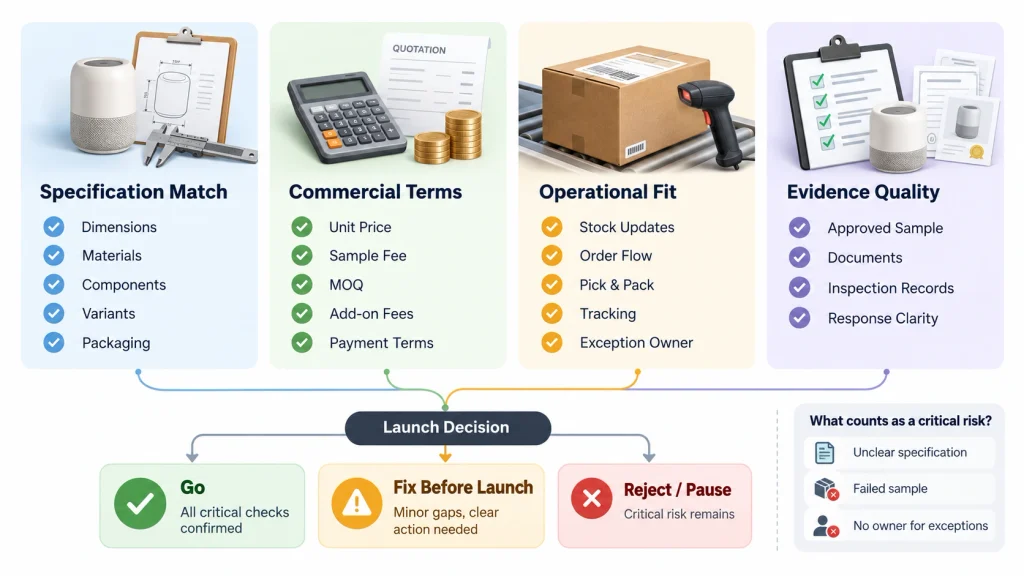
For a practical screening sheet, track:
- Specification match: what is confirmed, missing, or different?
- Commercial terms: item price, packaging, fees, minimum quantity, and payment conditions.
- Operational fit: stock visibility, processing workflow, parcel handling, and exception ownership.
- Evidence quality: documents, sample, inspection records, and responsiveness to specific questions.
Use a sample to test the product promise
A sample should answer a defined question. Compare it with the written brief: dimensions, finish, components, operation, assembly, labeling, and packaging where relevant. Record deviations. For size or color variants, sample those that create different customer expectations instead of assuming they are identical.
A single sample is a snapshot, not proof that every future unit will match. Ask how the supplier identifies the approved version and controls later changes. If the listing depends on a claim that cannot be verified from the sample or available documentation, remove or qualify that claim before publishing.
Consider the customer experience too. Can the item be packed without damage? Are instructions or included accessories clear? Does the unboxing create a mismatch with the product page? These checks are especially useful when the product’s perceived value depends on finish, presentation, or a complete set.
Test fulfillment and communication before scaling
A candidate can pass product checks and still fail operationally. Confirm how stock status is updated, what happens when a variant is unavailable, how orders are transmitted, and who handles a wrong item, damaged parcel, address issue, or tracking delay. Ask which steps the supplier performs and which belong to a separate fulfillment partner. Get the handoffs in writing.
Run a controlled test order using the intended workflow and destination. Record the time between order submission, processing confirmation, dispatch, and delivery; verify that the received item and packaging match the approved sample. One test does not establish a permanent service level, but it can expose unclear responsibilities and missing data before customer volume grows.
Evaluate communication by asking precise questions tied to the brief. Useful replies identify the item, answer the question, disclose uncertainty, and give a next step. A polished sales response that avoids specification or process details does not reduce operational risk.
Pickoship describes services that include product sourcing, quality checks, warehousing, and order fulfillment. If you need support beyond contacting individual sellers, review its China fulfillment services to understand the relevant workflow and confirm the service scope for your product and destinations.
Choose a product with a clear go or no-go threshold
Before testing, define the evidence needed to proceed: a written specification match, an acceptable sample, a landed-cost estimate, and a test order with named owners for exceptions. The threshold depends on product risk and listing claims.
Then categorize open issues as acceptable, fixable before launch, or disqualifying. A cosmetic difference might be fixable with an updated listing image; uncertain compatibility or a missing safety document may require more work or a different item. Keep a record of the approved version so later reorders can be checked against the same baseline.
If customization or branded packaging is part of the product decision, assess it separately from the base item. Ask about the required artwork, packaging specification, minimum quantities, and approval sample. Pickoship also presents private-label support as a service area; confirm whether the scope and order conditions fit the proposed test before treating customization as available.
Conclusion
Evaluating Chinese suppliers before choosing a dropshipping product means validating the relationship between a specific seller, a specific SKU, and the workflow that will serve the customer. Start with one product brief, compare equivalent offers, test the sample against customer-critical requirements, and verify how orders and exceptions will be handled. Move forward only when the evidence supports both the product promise and the operating model.
When you are ready to assess a candidate with an operations partner, share the product link or specification, required variants, destination markets, expected test quantity, and any packaging or quality requirements. You can discuss a product fit check with Pickoship with those details.
FAQs
Should I choose a factory over a trading company?
Not automatically. Choose based on control and accountability for the SKU. A factory may provide direct production visibility, while a trading company may coordinate multiple suppliers or variants. Verify who controls specifications, changes, quality checks, stock, and order exceptions.
What should I check in a supplier sample?
Compare the sample with the written specification and customer promise: critical dimensions, materials or components, operation, finish, included parts, and packaging. Record deviations and confirm how the approved version will be identified for later orders.
Can I evaluate a dropshipping product without visiting China?
Yes, some checks can be done remotely through documents, live video, samples, and a controlled test order. Remote evidence has limits, so keep claims conditional when a material attribute or production condition has not been independently verified.
When should I reject a supplier candidate?
Reject or pause when essential specifications remain unclear, commercial terms cannot be reconciled, the sample misses a customer-critical requirement, or no one accepts responsibility for order exceptions. Separate fixable gaps from risks that undermine the product promise.
Need numbers for your route?
Turn the research into a fulfillment plan.
Share your products, target markets, monthly order volume, and delivery target. We will identify which sourcing, inventory, and fulfillment questions need a verified quote.
No commitment. Route availability, pricing, and delivery times are confirmed in a written quote.