On this page20 sections
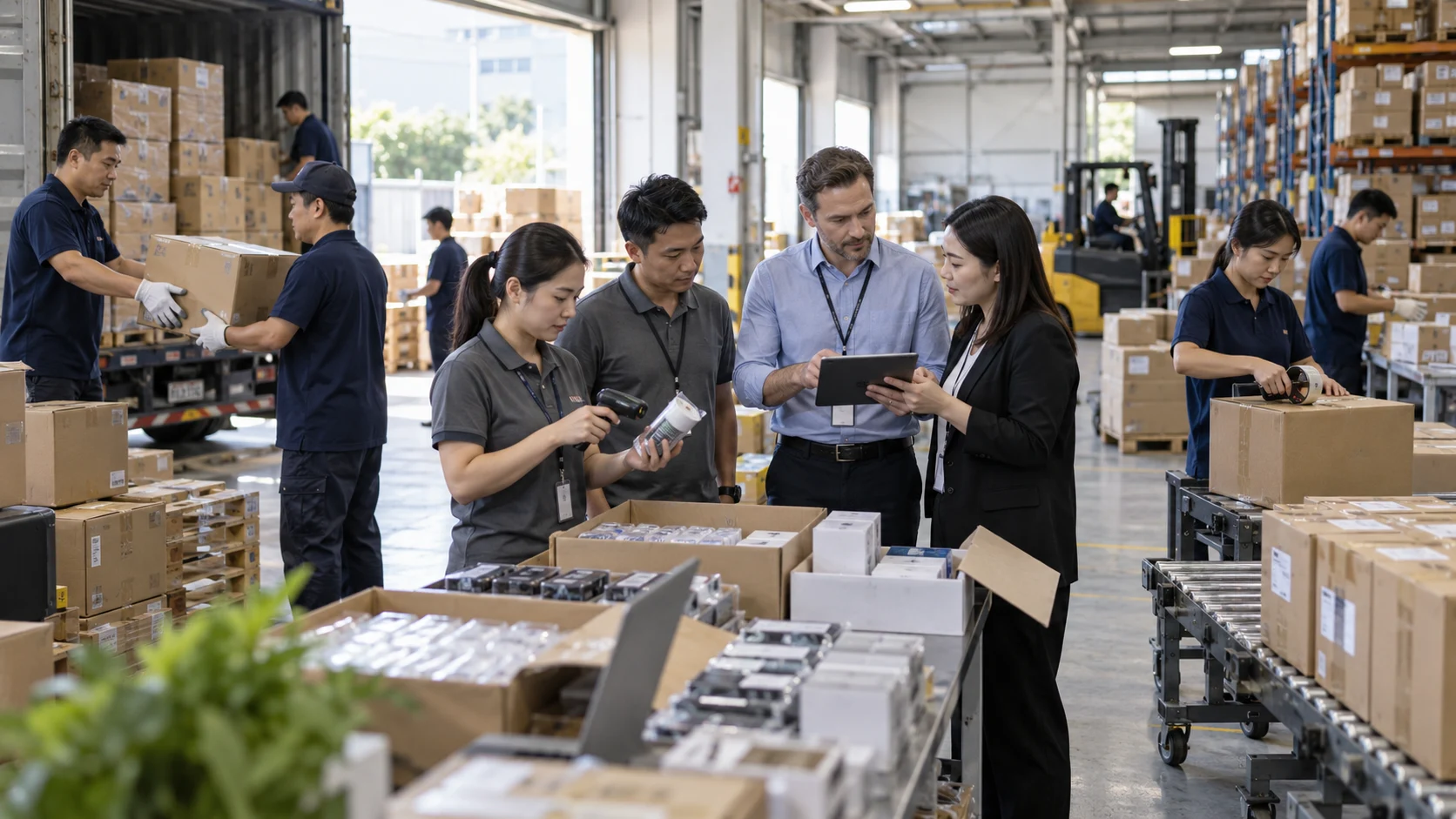
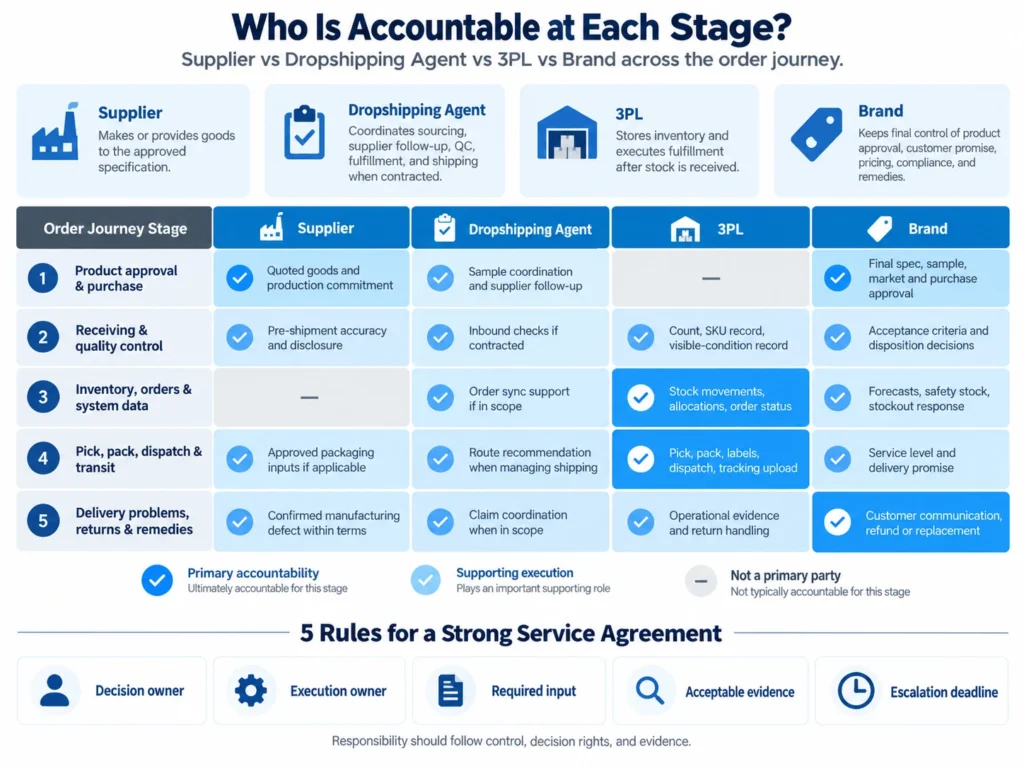
A supplier is accountable for providing goods to the approved specification. A third-party logistics provider (3PL) is accountable for agreed warehouse and fulfillment work after inventory is received. A dropshipping agent may coordinate sourcing, supplier communication, quality checks, fulfillment, and shipping, but only within the written scope. The brand remains accountable for product approval, legal and channel compliance, customer promises, pricing, and remedies. The practical rule is simple: responsibility should follow control, decision rights, and evidence.
The Three Roles in Plain Terms
These roles can overlap, especially when a single provider offers sourcing and fulfillment. The label on the contract matters less than the activities the party controls. Before assigning blame or choosing a partner, define the inputs, approvals, records, and exceptions for each activity.
Supplier: Makes or Provides the Product
A supplier may be a factory, wholesaler, or distributor. It owns conformance to the confirmed purchase order, approved sample, bill of materials, packaging requirements, quantities, and production timing it accepted. It should disclose substitutions and production exceptions before shipment. The supplier does not automatically own the brand’s market claims, import obligations, or customer service policy.
3PL: Executes Inventory and Order Fulfillment
A 3PL normally receives stock, records inventory, stores products, picks orders, packs parcels, hands them to carriers, returns tracking data, and processes agreed returns. Its accountability begins and ends with the service agreement. A warehouse scan can prove dispatch, for example, but it cannot guarantee carrier transit or the delivery date promised on a storefront.
Dropshipping Agent: Coordinates Across the Chain
A dropshipping agent can bridge work that would otherwise sit with several vendors: finding suppliers, comparing quotations, arranging samples, following production, checking inbound goods, fulfilling single orders, and selecting shipping routes. Some agents perform these tasks directly; others coordinate third parties. Accountability therefore depends on who performs each step and who holds the supporting records, not on the word agent alone.
Accountability Matrix
Use the following matrix as a contract starting point. Actual ownership should be adjusted for the product, destination, sales channel, and operating model.
| Activity | Supplier | Agent or 3PL | Brand |
| Product specification | Make or supply to the approved specification | Coordinate samples and changes if contracted | Approve product, claims, and sellable version |
| Inbound inventory | Provide correct quantity and shipment documents | Arrange or perform receipt and agreed QC | Set acceptance rules and disposition authority |
| Storage and records | Usually none after accepted delivery | Maintain locations, movements, and available stock | Forecast demand and approve stock policy |
| Order fulfillment | Only if contracted for direct dispatch | Pick, pack, dispatch, and return tracking | Set release rules and customer promise |
| Shipping exceptions | Support product or origin documentation | Investigate, document, and file eligible claims | Decide customer refund or replacement |
Where Accountability Changes During the Order Journey
Product Approval and Purchase
The supplier owns the accuracy of its quotation and the goods it accepts an order to produce. The agent owns quotation comparison, sample coordination, and purchase follow-up when those tasks are included. The brand must approve the specification, sample, intellectual-property position, destination-market requirements, and commercial commitment. No agent should substitute materials or place a bulk order without documented authority.
Receiving and Quality Control
The receiving party owns the count, SKU identification, visible-condition record, and quarantine of exceptions. Quality control must follow a written plan: inspection type, sample size, acceptance threshold, evidence, and escalation path. A visual inspection does not establish laboratory performance or regulatory compliance. The brand sets acceptance criteria and decides whether nonconforming stock is reworked, returned, discounted, or rejected.
Inventory, Orders, and System Data
The operator holding stock owns accurate movements, allocations, and order status. When stores are connected through an agreed ecommerce integration, the provider should define order import, tracking return, cancellation cutoffs, and a manual fallback. The brand still owns forecasts, campaign timing, safety stock, preorder rules, and the commercial response to a stockout.
Pick, Pack, Dispatch, and Transit
The fulfillment operator owns correct picking, approved packaging, labels, dispatch records, and timely tracking upload. For branded orders, version-controlled private-label packaging prevents unapproved substitutions. The provider may recommend an eligible route from current global shipping options, but the brand owns the service level and delivery language shown to customers. Warehouse processing time and carrier transit time should be measured separately.
Delivery Problems, Returns, and Customer Remedies
The logistics party owns operational evidence: scan history, packing records, carrier responses, claim deadlines, and return disposition options. The supplier owns verified manufacturing defects within the agreed terms. The brand owns customer communication, refunds, replacements, chargebacks, and goodwill decisions. Root-cause correction follows the failure: supplier quality, warehouse execution, carrier handling, or an inaccurate brand promise.
What Must Stay With the Brand
Outsourcing execution does not transfer the brand’s duty to decide what it sells and what it tells customers. The brand should retain final approval of product specifications, claims, compliance evidence, target markets, pricing, checkout promises, privacy practices, refund policy, and risk tolerance. It should also approve fallback rules for stockouts, packaging shortages, address changes, restricted goods, customs issues, and peak periods. Providers can supply facts and recommendations; the brand must make the market-facing decision.
Which Model Fits Your Operation?
Use a supplier directly when the brand can manage sourcing, inspection, inventory, fulfillment, and logistics itself. Use a conventional 3PL when products and replenishment are already controlled and the main need is reliable warehousing and order execution. Use a dropshipping agent when cross-vendor coordination, product sourcing, small-batch testing, or China-based supplier follow-up is part of the requirement. PickoShip can be evaluated as an integrated option when sourcing and fulfillment need one operating relationship. A hybrid can also work, but more handoffs make system ownership and exception escalation critical.
Put the Boundary in the Service Agreement
For every stage, record five items: the decision owner, execution owner, required input, acceptable evidence, and escalation deadline.
Add measurable rules for inbound counts, QC, inventory reconciliation, order cutoffs, packing versions, dispatch, tracking, claims, and returns. PickoShip’s fulfillment workflow covers receiving, agreed quality checks, storage, order synchronization, pick and pack, dispatch, tracking, and returns handling; the exact scope, eligibility, and service targets should still be confirmed for the SKU and destination.
Conclusion
The supplier, 3PL, and dropshipping agent are accountable for different forms of execution. The brand remains accountable for product and customer decisions. Clear approvals, evidence, and exception rules prevent gaps when roles overlap. Choose the operating model only after mapping each order stage to the party that controls it and can prove what happened.
FAQs
Is a dropshipping agent the same as a supplier?
No. A supplier provides or manufactures goods. An agent usually coordinates suppliers and may also provide QC, warehousing, fulfillment, and shipping, depending on the contract.
Is a dropshipping agent the same as a 3PL?
Not necessarily. A 3PL primarily manages inventory and logistics. An agent may include those services while also coordinating sourcing, samples, purchasing, or supplier issues.
Who is responsible when the wrong item reaches a customer?
Responsibility follows the cause. The supplier may have delivered mislabeled stock, the fulfillment operator may have picked incorrectly, or the brand may have mapped the SKU incorrectly. Records should identify the failure point.
Can a brand transfer product compliance to an agent or 3PL?
A provider can collect documents and coordinate checks, but the brand should retain accountability for confirming that the product, claims, and destination-market requirements are acceptable before sale.
To map responsibility for your SKUs, destinations, packaging, integrations, and daily order volume, request a written PickoShip fulfillment review before transferring inventory or live orders.
Need numbers for your route?
Turn the research into a fulfillment plan.
Share your products, target markets, monthly order volume, and delivery target. We will identify which sourcing, inventory, and fulfillment questions need a verified quote.
No commitment. Route availability, pricing, and delivery times are confirmed in a written quote.