
On this page18 sections
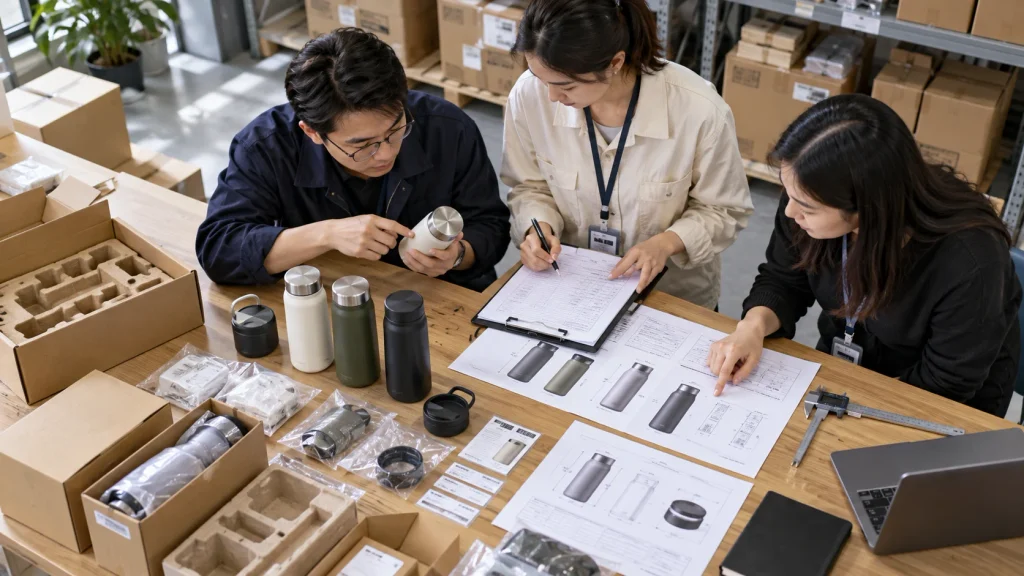
Local factory proximity gives a China dropshipping agent an advantage when it shortens a specific operating step: clarifying a specification, checking a revised sample, or resolving a discrepancy before stock leaves the supplier. The benefit depends on access to the people making decisions and a documented process for acting on their answers.
What factory proximity actually changes
China’s manufacturing clusters put factories, specialist workshops, component vendors, packaging suppliers, and local transport within reach of one another. A marketplace listing rarely reveals this network. A nearby agent can investigate who makes the item, who performs finishing work, and who must approve a change.
That information matters when a seller’s description differs from the production team’s specifications. The agent should confirm materials, dimensions, accessories, and packaging against an approved sample, with evidence attached to the purchase order.
Where proximity improves the operating cycle
Supplier communication and specification control
A local sourcing specialist can turn a product brief into a checklist and reach the production contact when a seller’s answer is incomplete. If the requested material or packaging is unavailable, nearby sources may offer alternatives that the buyer can assess before ordering.
Access becomes useful control when the agent records approved photos, sample notes, version dates, and packaging instructions. A substitution should require buyer approval even if it looks similar. Ask who can authorize a change and how the revised specification reaches both the supplier and the receiving warehouse.
Samples, prototypes, and change approval
A sample can reveal differences in finish, fit, color, or accessory compatibility. Near the production cluster, an agent may collect it, compare it with the brief, and return it for revision with fewer handoffs. That can shorten the approval cycle, particularly when several revisions are needed.
Visits, additional samples, rework, and urgent couriers may carry separate charges. Confirm what the coordination fee covers and who pays for changes requested after approval. Keep a reference sample or dated photo record so a later batch is checked against the accepted version.
Inbound quality checks and discrepancy handling
Before a batch leaves the supplier, the agent can check the agreed variant and packaging. At receiving, warehouse staff can count units, record visible damage, and perform agreed functional checks where practical. These checks need a defined scope; a visual inspection cannot establish every performance or safety characteristic.
Proximity helps when a discrepancy requires supplier evidence or replacement stock. The local contact may investigate while the remaining batch is accessible. Faster investigation does not guarantee that the supplier accepts responsibility, so remedy terms and approval authority should be agreed in advance.
Replenishment and exception escalation
For a fast-selling SKU, local access may help verify current capacity and packaging availability before a promotion. A backup supplier still needs sampling and approval; geographic convenience does not make its stock interchangeable.
Define when the agent must escalate, such as a failed sample, repeated damage, or a missed replenishment deadline. Specify who may hold stock and authorize rework. The useful speed measure is elapsed time from a reported problem to an approved action. Ask the agent to explain this sequence for an actual order, including delays awaiting buyer approval.
Factory proximity versus warehouse proximity
Factory proximity supports supplier discovery, sample movement, and production clarification. Warehouse proximity supports receiving, storage, packing, and parcel handoff. An agent can have one capability without the other.
Consider a merchant selling one standard SKU, holding limited stock, and requiring inspection before replenishment. Supplier access may help resolve a production question earlier. Warehouse execution matters once approved stock arrives. Compare providers using this same SKU, quantity, inspection scope, packaging brief, destination, and stockholding arrangement. Otherwise, apparent speed or price differences may simply reflect different service scopes.
Compare the same scenario for cost, speed, and control
Under those shared conditions, each model places cost and responsibility differently. These are conditional effects to verify in a quote.
| Operating model | Cost effect | Speed effect | Control effect |
| Remote listing purchase | Verification and rework may add to the unit quote. | Simple ordering; exceptions may take longer. | Buyer must establish approvals and evidence. |
| Local agent with supplier access | Visits and QC add fees; earlier checks may avoid rework. | May shorten sample and correction cycles. | Agent can document changes and escalate locally. |
| Direct factory relationship | Buyer absorbs coordination costs and any minimum-order commitment. | Direct communication; production capacity still limits speed. | Buyer manages specifications, inspection, and remedies. |
| Warehouse fulfillment only | Source checks may need a separate service. | Supports dispatch after stock arrives. | Covers inventory handling; production control needs separate access. |
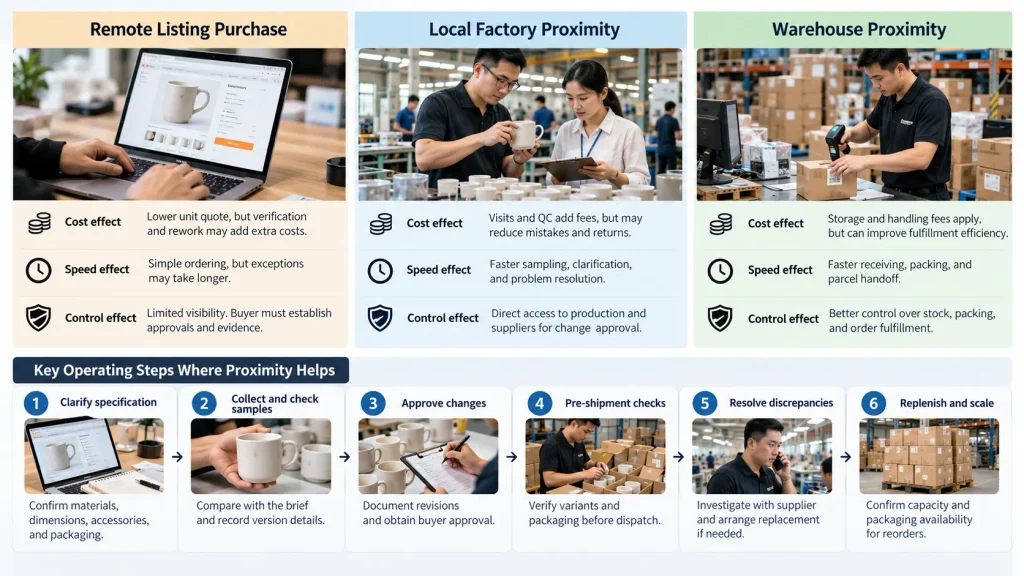
This is a decision framework, not a promise of savings. Ask for a line-item quote covering receiving, storage, pick-and-pack, shipping, custom packaging, QC, returns, and any factory visit or urgent coordination fee.
When proximity does not create an advantage
Distance alone cannot verify a supplier’s financial stability, labor practices, intellectual property position, or long-term quality consistency. A nearby workshop may still subcontract critical steps. A local contact may also favor a familiar source that does not fit the buyer’s specification. Factory proximity does not guarantee open capacity, lower prices, faster customs clearance, or faster delivery to the customer’s country.
It can even add cost when the product needs repeated sampling, on-site testing, custom packaging, or small-batch rework. Buyers should compare the total operating cost and the value of earlier information, not just the distance on a map. If the product is simple, stable, and already stocked in the right location, warehouse execution may matter more than factory visits.
How to verify an agent’s local operating capability
Before appointing a China dropshipping agent, ask for evidence in five areas:
- Location and roles: Which team operates near the supplier cluster, and which team handles warehouse and dispatch work?
- Supplier verification: Can the agent identify the actual production party and explain any trading-company or workshop involvement?
- Sample and QC records: Will you receive dated photos, sample notes, inspection results, and discrepancy records tied to your SKU?
- Escalation rules: Who approves a substitution, rework, hold, or refund, and what response time is targeted?
- Commercial scope: Which activities are included in the quote, and which trigger additional fees or cut-off requirements?
A credible answer connects people, places, documents, and decisions. It should also explain what happens when the local answer is “not available” or “not yet confirmed.”
How Pickoship applies local coordination
Pickoship’s Shenzhen team has worked in sourcing and fulfillment since 2012. Its services cover sourcing, quality inspection, inventory storage, packing, and global shipping. The main fulfillment center is in Shenzhen, with a warehouse in Dongguan, within Guangdong’s manufacturing and freight network. Review its company and operating model for the broader service scope.
The Shenzhen center supports inbound QC, SKU storage, sourcing support, and primary parcel dispatch. The Dongguan warehouse handles bulk inventory, kitting, bundle assembly, and overflow capacity. The China fulfillment workflow connects supplier coordination with inspection, storage, packing, and dispatch. Confirm cut-off conditions, product restrictions, and exception handling before approving an order.
For a real comparison, send the same brief to the agent and ask for the same assumptions: target specification, sample requirement, inspection points, inventory plan, destination, and expected order pattern. Then compare the written quote and evidence plan. Where delivery choices are material, review the available global shipping options rather than assuming that a local factory location determines the final transit time.
Conclusion
Local factory proximity creates an operational advantage when it turns physical access into faster verification, clearer specifications, and accountable exception handling. It is most valuable for products that require sampling, customization, quality checks, or frequent replenishment. It is less decisive when the product is standardized and the main challenge is warehouse execution.
Ask for written responsibilities, approval rules, and exception procedures. Compare the same business conditions and confirm the scope behind each cost or speed claim.
FAQs
Does a nearby factory always mean a lower product cost?
No. Factory proximity may reduce coordination or rework time, but visits, samples, inspection, packaging changes, and urgent local transport can add fees. Compare total landed and operating cost.
Can factory proximity shorten international shipping time?
Usually it affects the upstream handoff, not the carrier’s international transit. Customs, service level, destination, and dispatch cut-off still determine delivery timing.
What evidence should an agent provide after a local inspection?
Request dated photos, quantity and condition notes, agreed functional checks where applicable, packaging observations, and a record that links the result to the approved SKU version.
Is a warehouse-only provider unsuitable for dropshipping?
Not necessarily. A warehouse-led model can work well for stable, pre-verified inventory. It becomes less suitable when the buyer needs frequent supplier changes, customization, or source-side escalation.
Plan a sourcing review
For a sourcing review, send the product brief to Pickoship’s team with specifications, packaging requirements, expected quantity, destination markets, and known quality concerns. Ask which local checks are proposed and how their cost and approval steps will be documented.
Need numbers for your route?
Turn the research into a fulfillment plan.
Share your products, target markets, monthly order volume, and delivery target. We will identify which sourcing, inventory, and fulfillment questions need a verified quote.
No commitment. Route availability, pricing, and delivery times are confirmed in a written quote.