On this page16 sections

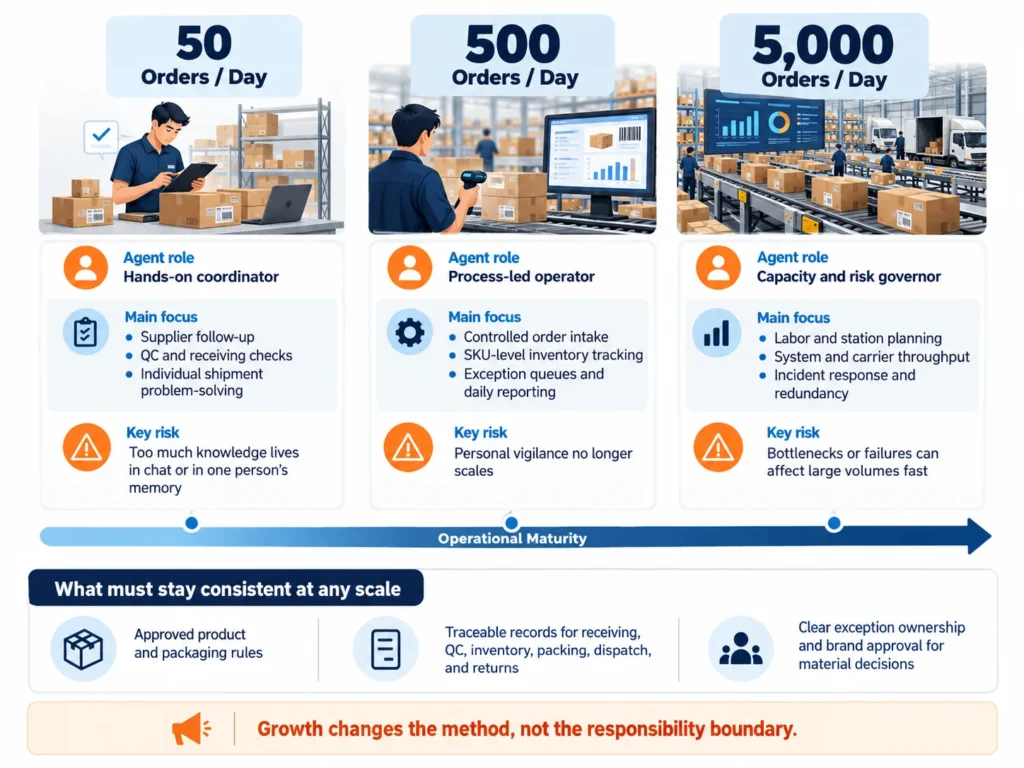
At roughly 50 daily orders, a dropshipping agent is mainly a hands-on coordinator: keeping suppliers aligned, checking product quality, and resolving individual shipment problems. At 500 orders, the role must become process-led, with reliable order sync, inventory control, documented exceptions, and backup ownership. At 5,000 orders, the agent is no longer simply managing orders. The job becomes capacity governance across people, systems, warehouse flow, suppliers, and shipping routes.
These volumes are planning scenarios, not universal thresholds. One stable SKU can be easier to handle than a smaller catalog with many variants, suppliers, bundles, destinations, or custom packing steps. For the separate decision about provider structure, review choosing between a solo agent, agency team, or platform. The focus here is different: how the agent’s operating responsibility should mature as transaction volume and failure exposure rise.
Why Daily Volume Changes the Agent’s Job
More orders create more than additional picking work. They multiply handoffs, inventory movements, address changes, stockout risks, tracking events, and carrier exceptions. The cost of informal communication also rises. A missed message at 50 orders may affect one parcel; the same weak control at 5,000 orders can produce a queue of repeated errors before anyone sees the pattern.
The agent’s progression should therefore be measured by control maturity: from personal follow-up, to repeatable workflows, to system-wide capacity and risk management. The brand still owns the product specification, market promise, compliance decisions, pricing, and customer policy. The agent owns agreed physical execution, operational records, and timely escalation.
At 50 Orders a Day: Coordinate, Verify, and Learn
At this stage, direct communication can still work well. The agent should coordinate suppliers, confirm that the approved item is purchased, receive stock, apply the agreed inspection, pack correctly, select an eligible shipping route, and return tracking. The most valuable contribution is context: knowing which supplier made the item, which sample was approved, and why an exception occurred.
The operating risk is personal dependency. If specifications, approvals, or stock adjustments live only in chat, the business cannot reliably cover absence or a sudden campaign. Even a small operation should connect daily execution to documented order fulfillment operations rather than rely on memory.
The minimum control set
- One master SKU file with approved variants, packaging, and supplier references.
- A written receiving and quality-control checklist with an exception photo rule.
- A daily review of paid orders, holds, cancellations, stockouts, and parcels awaiting tracking.
- A weekly scorecard separating warehouse processing from carrier transit.
At 500 Orders a Day: Build a Repeatable Operating System
At 500 daily orders, personal vigilance is not a control system. The agent’s role shifts from doing or checking every task to designing a workflow that other people can execute consistently. Account management, purchasing, quality control, warehouse work, and logistics need named owners, shared records, and backup coverage.
Order data should enter through a defined store integration scope or a controlled import process, with a documented manual fallback. Inventory movements should be recorded by SKU and status. Order edits need a cutoff. Stock discrepancies, failed syncs, address holds, and packing substitutions need queues with owners and resolution times.
What the agent must add
- Role-based work queues so routine orders and exceptions do not compete for attention.
- Cycle counts and inventory reconciliation tied to receiving, allocation, picking, and returns.
- Version control for QC rules, inserts, labels, and branded packaging components.
- Daily operational reporting on backlog, dispatch, stock accuracy, and unresolved exceptions.
Automation becomes useful here, but only for stable rules. It can move order and tracking data, flag low stock, and route standard tasks. It should not silently approve a product substitution, release quarantined inventory, or change a shipping promise. Those decisions need explicit authority.
At 5,000 Orders a Day: Govern Capacity and Risk
At 5,000 daily orders, the agent must operate as a supply-chain control function. The question is no longer whether today’s team can work faster. It is whether receiving docks, inspection stations, storage locations, packing lines, systems, suppliers, and carrier allocations can absorb normal volume, peaks, and failures without losing traceability.
Capacity plans should translate forecasts into labor, workstations, inventory space, packaging supply, system throughput, and carrier handover requirements. The agent should model credible peaks, define when new intake is paused, and show how priority rules work. For multiple markets, approved cross-border shipping options need alternatives because product eligibility, customs events, line conditions, and peak seasons can change route availability.
What the operating model must prove
- Redundant ownership for every critical queue, approval, system, and carrier escalation.
- Capacity triggers based on backlog age, inventory variance, exception rate, and dispatch performance.
- Incident routines that contain affected orders, preserve evidence, identify root cause, and authorize recovery.
- Supplier and carrier diversification based on verified product and route fit, not an assumed universal backup.
At this scale, a dedicated contact remains useful, but that person should coordinate a documented operating structure. They should not be the only place where decisions, evidence, or escalation history exist.
What Should Not Change at Any Scale
Growth changes the method, not the responsibility boundary. The agent should execute the approved specification, record what happened, and escalate material exceptions. The brand should retain final approval over product claims, compliance path, customer promise, refund policy, and any substitution that changes what the customer receives.
Evidence should remain proportional to risk. Receiving counts, inspection results, inventory adjustments, packing exceptions, dispatch timestamps, tracking events, and return disposition all need a traceable record. A dashboard can make that record visible, but it does not replace clear ownership or an agreed response when data is wrong.
How to Tell Whether an Agent Is Ready for the Next Stage
Ask for capacity evidence before moving more volume. The agent should explain the current baseline, the busiest credible week, available labor and stations, storage constraints, system limits, carrier handover capacity, and the trigger for adding resources. A promise to handle growth is not the same as an operating plan.
- Run a representative pilot. Include normal orders, edits, stockouts, split shipments, damaged units, and a carrier exception.
- Inspect the records. Confirm that receiving, QC, inventory, packing, dispatch, and claims share stable identifiers.
- Test escalation. Identify who decides, who executes, who covers an absence, and when the brand must approve.
- Reconcile the commercial model. Separate sourcing, receiving, storage, pick and pack, custom work, shipping, returns, and exception fees.
- Expand in stages. Increase SKU and order volume only after inventory, dispatch, tracking, and exception records reconcile.
Where Pickoship Fits
Pickoship combines a dedicated account contact with sourcing, quality control, warehouse, packing, dispatch, and tracking functions. Its public service pages describe store connections, SKU-level inventory records, agreed checks, tracked cross-border shipping, and written qualification rules. This structure is relevant when a brand needs managed execution supported by systems rather than a single informal coordinator.
Fit still depends on the actual SKU mix, inbound condition, special handling, destinations, order profile, and peak plan. No public service description proves capacity for a particular 500- or 5,000-order day. Those requirements, cutoffs, exceptions, route eligibility, and commercial terms should be confirmed in writing before inventory or traffic is moved.
Conclusion
A dropshipping agent creates different value at different scales. At 50 orders a day, the role is coordination and learning. At 500, it is process ownership and reliable data. At 5,000, it is capacity, resilience, and risk governance. The right partner is not the one that accepts the largest number. It is the one that can show how control changes before volume exposes the next weak point.
FAQs
Is 50 orders a day the point when a store needs a private agent?
Not necessarily. The decision depends on supplier count, SKU complexity, quality-control needs, customization, destinations, and exception risk as well as volume.
Can one dropshipping agent manage 500 orders a day?
Possibly, but execution should not depend on one person. Verify team coverage, systems, warehouse capacity, shared records, and an escalation process through a representative pilot.
What changes first when order volume grows?
Informal communication should give way to controlled order intake, SKU-level inventory, exception queues, versioned work instructions, and regular operational reporting.
Does automation replace the agent at high volume?
No. Automation moves standard data and tasks. Human ownership remains necessary for supplier decisions, quality exceptions, route changes, incidents, and approvals outside defined rules.
To test whether Pickoship’s operating model fits the next stage, share the SKU count, suppliers, current and peak daily orders, inbound status, packaging steps, store platform, target markets, and delivery promise, then request a written fulfillment review.
Need numbers for your route?
Turn the research into a fulfillment plan.
Share your products, target markets, monthly order volume, and delivery target. We will identify which sourcing, inventory, and fulfillment questions need a verified quote.
No commitment. Route availability, pricing, and delivery times are confirmed in a written quote.