On this page13 sections

A dropshipping order crosses five operating boundaries: the brand promises the product, the factory makes it, the agent coordinates the handoffs, the warehouse controls physical fulfillment, and the carrier moves the parcel. A RACI framework makes those boundaries explicit before an exception forces people to negotiate them under pressure.
The matrix below is a planning tool, not a replacement for a manufacturing agreement, fulfillment plan, carrier terms, or customer policy. It gives each activity one accountable owner, at least one responsible executor, and a defined consultation or notification path. Apply it to the real SKU, packaging, destinations, order flow, and escalation rules before launch.
What RACI Means in a Dropshipping Supply Chain
RACI stands for Responsible, Accountable, Consulted, and Informed. Responsible means the role performs or controls the work. Accountable means one role owns the final outcome or decision. Consulted roles provide input before the work is completed. Informed roles receive the result or status without becoming an approval gate.
Two rules prevent most RACI charts from becoming decorative spreadsheets. First, assign exactly one A to each row unless the row is split into separate decisions. Second, give every row an R that can actually perform the task. If a role is both R and A, mark A/R and confirm that the combination will not create a bottleneck.
Define the Five Roles Before Filling the Grid
The same company may occupy more than one column, but the operating duties should still remain visible. A private dropshipping agent may coordinate a warehouse or factory relationship, yet coordination is not the same as receiving stock, approving claims, or accepting a parcel into a carrier network.
- Brand: owns the customer promise, product claims, approved specification, commercial policy, refund authority, and final risk decisions.
- Dropshipping agent: coordinates sourcing, supplier communication, order exceptions, documentation, route choices, status reporting, and escalation between parties.
- Factory: makes the approved item, controls production readiness, supplies batch and carton information, and corrects manufacturing defects within the agreed scope.
- Warehouse: receives, counts, inspects, stores, picks, packs, records inventory, and hands eligible parcels to the selected carrier or line.
- Carrier: accepts the parcel, moves it through the quoted route, reports tracking and transit events, and manages carrier-side delivery exceptions.
Core RACI Matrix for the Order Lifecycle
Use this matrix as a starting point for a dropshipping fulfillment plan. Replace a broad row with a more specific one when the risk changes, such as separating product compliance from packaging approval or separating customs documentation from last-mile delivery.
| Lifecycle task or decision | Brand | Agent | Factory | Warehouse | Carrier |
| Product promise, claims and compliance path | A/R | C | C | I | I |
| Approved specification and sample release | A | C | R | I | I |
| Production plan and batch readiness | A | R | R | I | I |
| Inbound booking, ASN and carton data | I | A | R | R | C |
| Receiving, agreed QC and stock release | I | A | C | R | I |
| Order sync, holds and address exceptions | A | R | I | C | I |
| Pick, pack and branded inserts | A | C | C | R | I |
| Route selection and carrier handover | C | A | I | R | R |
| Transit exception and customer escalation | A | R | I | C | R |
| Returns, refunds and disposition policy | A/R | R | C | R | C |
| Root-cause review and corrective action | A | R | R | R | C |
R = Responsible, A = Accountable, C = Consulted, I = Informed. A/R means the same role performs the work and owns the outcome; use it sparingly.
How to Use the Matrix Without Creating Deadlocks
RACI works when each letter changes a real behavior. A consulted factory must answer a specification question before production is released. An informed brand must receive the receiving variance even if it does not recount the carton. A responsible agent must own the exception queue rather than simply forward messages. Write the response time, evidence required, and escalation trigger beside each high-risk row.
Keep decisions separate from physical execution. For example, the brand can be accountable for a customer promise while the carrier is responsible for the transit event. The warehouse can be responsible for dispatching the parcel while the agent is accountable for selecting an eligible route under the approved commercial scope. This separation prevents a tracking delay from becoming an argument about who owns the customer response.
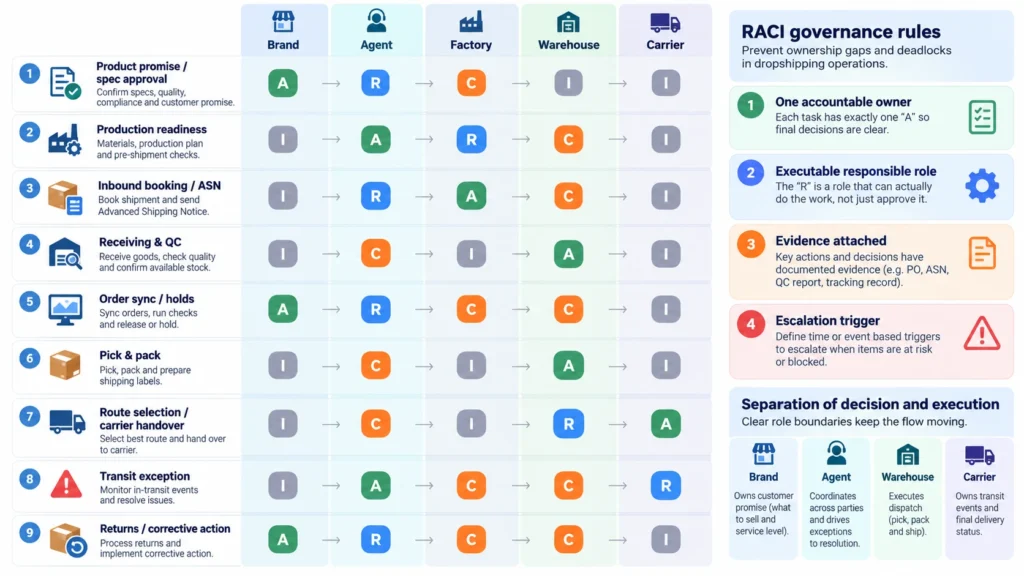
- Attach evidence to the row: approved artwork, QC photos, carton count, inventory adjustment, scan event, tracking record, or customer decision.
- Define the handoff: what must be complete before the next role accepts responsibility, and which system or file records that acceptance.
- Set an exception owner: the person who opens the case, keeps the record current, and closes it after the agreed remedy is verified.
Connect the RACI to the Actual Fulfillment Workflow
Pickoship describes a connected flow from factory or supplier inbound through receiving, agreed QC, SKU-level storage, store order sync, pick-and-pack, and cross-border dispatch. For a brand using that type of operating model, the RACI should be attached to the same milestones rather than kept as a separate management document. Review the published fulfillment process and convert each stated scope or exception into an owner, evidence field, and escalation rule.
System boundaries also need an owner. Pickoship lists supported channels, inventory and tracking synchronization, CSV import, and Open API options, while noting that events and availability vary by account, channel, and region. Confirm the exact store integration scope and assign responsibility for failed syncs, manual fallback, order edits, and duplicate or missing tracking updates.
Carrier rows should distinguish warehouse processing from transit. Pickoship’s global shipping guidance separates those stages and states that route and product eligibility, packed dimensions, customs events, remote areas, and peak conditions can change the result. Review the cross-border shipping scope before assigning a delivery promise to a carrier row.
Validate the RACI Before Moving More Volume
A matrix is ready for operational use when each role can answer three questions: What do I do? What evidence do I produce? When do I escalate? Test it with representative cases instead of reviewing only the happy path.
- Run a pre-launch walkthrough for a normal order, a stock discrepancy, a QC failure, an address hold, a route change, a customs delay, and a return.
- Check for duplicate accountability. If two parties both believe they can approve a substitution, split the decision and name one final owner.
- Check for silent gaps. Every handoff should have a record, a due time, and a person who notices when the next event does not arrive.
- Reconcile the commercial boundary. Separate manufacturing, receiving, storage, pick-and-pack, custom work, shipping, returns, and exception fees.
- Review the chart after a material change in SKU, destination, packaging, sales channel, carrier route, or order volume.
Where Pickoship Fits
Pickoship presents a private-agent and China-fulfillment model that connects sourcing, quality checks, warehouse operations, store integrations, packing, and global dispatch. That makes it a natural coordination point for the agent column, but the RACI should still preserve the brand’s approval rights and the factory, warehouse, and carrier’s execution records.
Published service terms are planning inputs, not universal guarantees. Eligibility, cutoffs, product restrictions, exceptions, and remedies should be confirmed for the actual product and route. A written plan is more useful than a generic promise because it gives every row in the matrix a measurable boundary.
Conclusion
A RACI framework turns a dropshipping supply chain from a group of overlapping conversations into an operating agreement. The brand owns the promise and final decisions. The agent coordinates information and exceptions. The factory, warehouse, and carrier own the physical stages they control. When every task has one accountable owner, an executable responsible role, and a defined evidence trail, problems can be routed before they become customer-facing failures.
FAQs
Can the dropshipping agent be accountable for every task?
Usually not. The agent can coordinate the workflow and own escalation, but the brand should retain decisions about product claims, customer promises, refunds, and material substitutions. Factory, warehouse, and carrier responsibilities should remain visible.
Should the factory and warehouse share one RACI column?
Only when the same team truly controls both stages and the evidence is stored together. Separate columns are safer when receiving, QC, storage, or dispatch is performed by a different party.
How many accountable owners can one RACI row have?
Use one accountable owner for each decision or deliverable. If two approvals are genuinely different, split the row into two decisions instead of assigning two As to one unresolved outcome.
Is RACI a substitute for a service-level agreement?
No. RACI clarifies ownership. A service-level agreement or written fulfillment plan should define timing, evidence, eligibility, fees, remedies, and what happens when an exception falls outside the normal process.
To turn this framework into a product-specific operating plan, share the SKU list, approved specifications, factory status, inbound data, store platform, destinations, packaging steps, order volume, and carrier requirements, then request a written fulfillment review.
Need numbers for your route?
Turn the research into a fulfillment plan.
Share your products, target markets, monthly order volume, and delivery target. We will identify which sourcing, inventory, and fulfillment questions need a verified quote.
No commitment. Route availability, pricing, and delivery times are confirmed in a written quote.