On this page15 sections

When a store owner searches for a China dropshipping agent, the first useful question is not which city is cheapest. It is which local supply cluster can meet the same product brief, inspection standard, dispatch plan, and margin target with the fewest handoffs. Yiwu, Shenzhen, Guangzhou, and other manufacturing centers solve different operating problems.
A practical agent narrows the search by matching the SKU to its supply network, then checking what can be proved on site: a current sample, a supplier’s production role, variant consistency, packing requirements, and the route from receiving to dispatch. That process changes the decision from a city label into a controlled comparison. Under the same destination, order volume, QC checklist, packaging, and delivery promise, the right location is the one that reduces avoidable cost and delay without taking visibility away from the brand.
Why location changes the operating model
Distance matters, but it is only one part of landed cost. A supplier near the right cluster may reduce transfers, consolidation, and sampling time. A supplier in the wrong cluster can add those costs even when its unit price looks lower. Product complexity matters too: electronics need technical iteration and component access, while home accessories may benefit from wholesale choice.
Location also changes speed and control. A market with many listings may speed discovery, while a factory corridor can shorten sample revisions. A nearby fulfillment center may shorten the handoff after goods arrive. Measure each stage separately and ask who owns communication, inventory records, checks, and exceptions.
What each major cluster is good at
Yiwu: breadth, comparison, and small-batch variety
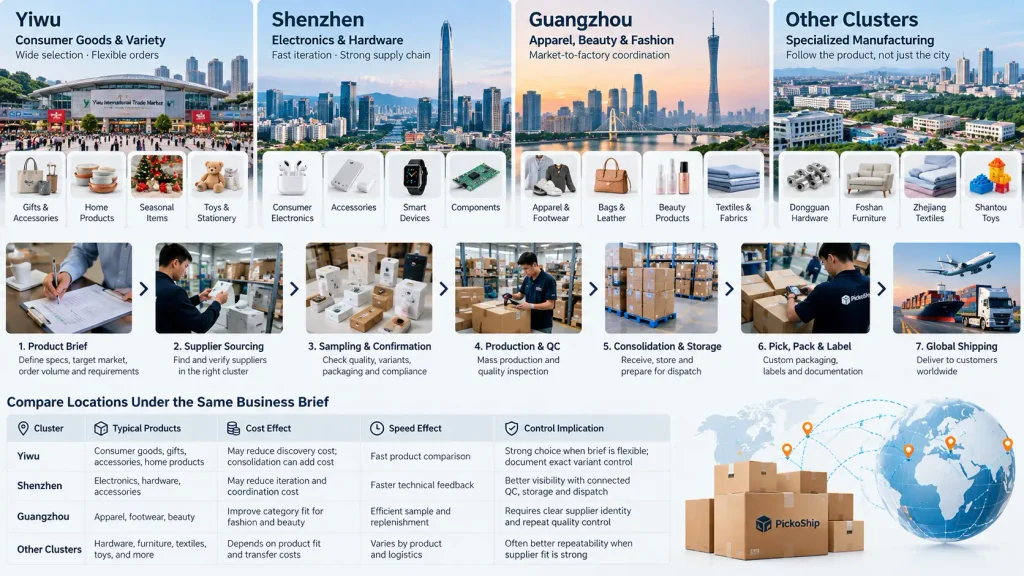
Yiwu is often associated with dense wholesale markets and a wide range of consumer goods, gifts, accessories, seasonal items, and home products. Its advantage is search breadth. An agent can compare many similar products, finishes, and packaging options during one sourcing cycle.
That breadth can lower discovery cost when the brief is flexible. Similar listings may differ in material, dimensions, or packing, so record the supplier and approve a current sample before consolidation. Yiwu suits assortment-led testing, but it is not automatically the lowest landed-cost option after inspection and domestic transfers.
Shenzhen: electronics, iteration, and fulfillment adjacency
Shenzhen is closely linked with consumer electronics, accessories, and hardware. Local technical suppliers can make sample feedback on components, batteries, or connectors more actionable before a SKU scales. When sourcing and fulfillment share an operating plan, Shenzhen can also reduce handoffs. A written specification and destination checks remain necessary.
Guangzhou: apparel, beauty, and market-to-factory coordination
Guangzhou is commonly used for apparel, footwear, leather goods, and beauty products where market samples and factory capability should be compared. Check sizing, material or finish, color, labels, and packaging. Since a market seller may not be the factory, confirm who owns repeat quality and replenishment.
Elsewhere: follow the product cluster, not the headline city
Other products may fit specialized clusters such as Dongguan for hardware, Foshan for furniture, or Zhejiang and Shantou for textiles and toys. Treat these as starting hypotheses. A farther cluster may still be preferable if it offers better supplier fit or repeatability and the agent can manage the transfer into fulfillment.
Compare every option under one business brief
To compare locations fairly, hold the operating conditions constant. Use the same SKU specification, destination countries, daily order range, packaging brief, QC checklist, and delivery target. Ask each route to show product cost, domestic movement, receiving, storage, pick-and-pack, shipping, and any special handling separately.
| Option | Cost effect under the same brief | Speed effect | Control implication |
| Yiwu market-led search | May reduce discovery cost and broaden alternatives; consolidation and rechecking can add cost | Fast product comparison; production and transfer time vary | Strong choice when the brief is flexible; exact variant control must be documented |
| Shenzhen technical network | May reduce iteration and coordination cost for electronics and hardware | Faster feedback when technical suppliers and fulfillment are connected | Better visibility when QC, storage, and dispatch share one operating plan |
| Guangzhou market-to-factory search | Can improve category fit for fashion and beauty; extra checks may affect total cost | Efficient sample comparison; repeat production depends on the actual factory | Requires clear ownership of specifications, sizing, labeling, and replenishment |
| Specialized or nearby cluster | May improve unit economics or capability for a narrow product | Can add domestic transfer time, but may reduce rework | Worth choosing when the agent can prove supplier access and downstream control |
The comparison exposes trade-offs, not a city ranking. A lower unit price can be offset by packing, rework, or shipping. A faster sample does not mean faster fulfillment if approved stock is not available.
How a China dropshipping agent narrows the search
An effective sourcing workflow turns local information into comparable evidence:
- Classify the SKU. Identify material, dimensions, variants, functional requirements, packaging, destination markets, and any battery, liquid, cosmetic, or children’s-product restrictions.
- Map the likely cluster. Start with one primary cluster and one fallback. The goal is not to contact every supplier; it is to test the most relevant network first.
- Request comparable proof. Ask for the same sample details, current photos, packed dimensions, carton information, production role, and repeat-order terms from each candidate.
- Inspect before scaling. Confirm count, visible condition, key features, and packaging against the approved brief. Record discrepancies before stock is accepted.
- Connect sourcing to fulfillment. Set the receiving location, inventory record, exception owner, and route after pick-and-pack.
On-site information is valuable when it clarifies whether listings match, what role a supplier plays, or how packaging affects parcel cost. The output should be a comparable quote and evidence trail, not a vague claim of factory access.
What to verify before appointing the agent
Ask for a written plan that answers these questions:
- What exact product and variants are being sourced, and who approves the sample?
- Which checks are included at receiving, and how are failed units quarantined or replaced?
- Which costs are fixed, which vary by packed parcel, and which services are quoted separately?
- What is the processing target after order sync, and what is outside that target?
- Who owns inventory records, exception communication, and the decision to change a supplier or route?
Run a small paid pilot. Compare the batch with the approved sample, inspect the parcel, and record the time from order sync to carrier handoff.
When a China-based operating partner fits
PickoShip presents a Shenzhen-based team and a Guangdong manufacturing-belt workflow covering sourcing, agreed checks, storage, packing, and global dispatch. Its public service pages describe receiving factory inventory, recording it by SKU, and handing packed orders to a cross-border route. Confirm scope, eligibility, and fees for the product and destination.
This model can fit a brand that wants one accountable workflow while comparing suppliers in more than one cluster. It can also fit a seller that already has a factory but needs receiving, inspection, inventory control, and customer-order dispatch. Review the PickoShip fulfillment process and the company’s sourcing and operating model before moving stock.
For a broader supplier-screening checklist, use this guide to finding reliable dropshipping suppliers and apply the same SKU, sample, and pilot-order tests to every candidate. When the brief is ready, request a fulfillment review with the product link or photos, variants, destinations, expected daily orders, packaging needs, and target delivery promise.
Conclusion
Yiwu, Shenzhen, Guangzhou, and other Chinese clusters are not interchangeable labels. Yiwu can widen assortment discovery, Shenzhen can support technical iteration and fulfillment adjacency, Guangzhou can help coordinate fashion and beauty supply, and another cluster may be the better fit for a specialized SKU. The decision becomes reliable when every option is compared under the same business conditions and supported by the same evidence: sample quality, supplier role, domestic movement, fulfillment scope, and route-specific cost.
A capable China dropshipping agent narrows the search by turning local access into documented choices. That is the real advantage of being on the ground: not a promise that one city is always best, but better information before the brand commits money and inventory.
Frequently asked questions
Is Yiwu always the cheapest place to source dropshipping products?
No. Broad choice can help comparison, but landed cost also includes consolidation, domestic movement, inspection, packaging, and cross-border shipping.
Is Shenzhen always the fastest option?
No. It may shorten technical communication or fulfillment handoff, but capacity, sample approval, cut-off times, customs, and route still determine speed.
Can one agent source from more than one Chinese city?
Yes, if the agent can document the supplier network and receiving plan. Ask how goods are consolidated, checked, recorded, and replenished.
Next step: Share your SKU, destinations, order range, packaging requirements, and delivery promise with PickoShip for a product-fit and fulfillment-scope review.
Need numbers for your route?
Turn the research into a fulfillment plan.
Share your products, target markets, monthly order volume, and delivery target. We will identify which sourcing, inventory, and fulfillment questions need a verified quote.
No commitment. Route availability, pricing, and delivery times are confirmed in a written quote.