On this page14 sections
Your factory says the goods shipped. The carrier says they were delivered. Your store still shows zero available inventory.
That gap is where many fulfillment problems begin. Cartons can arrive without a usable reference, variants can be mixed, quantities can differ from the packing list, and products can pass a basic count while failing the quality checks required for release. If the brand, factory, and 3PL use different definitions of “received,” a launch can be delayed before the first customer order reaches the warehouse.
This guide gives DTC operators a practical factory-to-warehouse receiving process. It is especially useful when products are manufactured in China and sent to one China fulfillment warehouse for storage, pick and pack, and international parcel delivery.
The Factory-to-Warehouse Receiving Checklist
Use this as the operating summary. The detailed steps and exception rules follow.
| Stage | What must be ready | Release evidence |
|---|---|---|
| 1. Product setup | Unique SKU and variant mapping, barcode decision, packed dimensions, special attributes | Approved product master |
| 2. Receiving instructions | Warehouse address, contact, inbound reference, carton and label rules | Written receiving guide shared with the factory |
| 3. Pre-alert or ASN | Supplier, shipment, SKU, quantity, carton, tracking and document data | ASN or inbound record created before dispatch |
| 4. Factory pack-out | Correct units per carton, labels visible, mixed SKUs identified, packing list attached | Factory photos and final packing list |
| 5. Arrival check | Shipment identity, carton count and visible external damage | Timestamped arrival and damage record |
| 6. Reconciliation | Expected versus received SKU quantities | Receiving count and discrepancy report |
| 7. Agreed-scope QC | Defined sample or unit checks, acceptance criteria and evidence | Pass, hold, rework, return or disposal decision |
| 8. Putaway and activation | Inventory owner, location and stock status recorded | Available quantity shown in the agreed system |
| 9. Order-release test | Store mapping, sample order, pick and tracking workflow verified | Approved test order before launch |
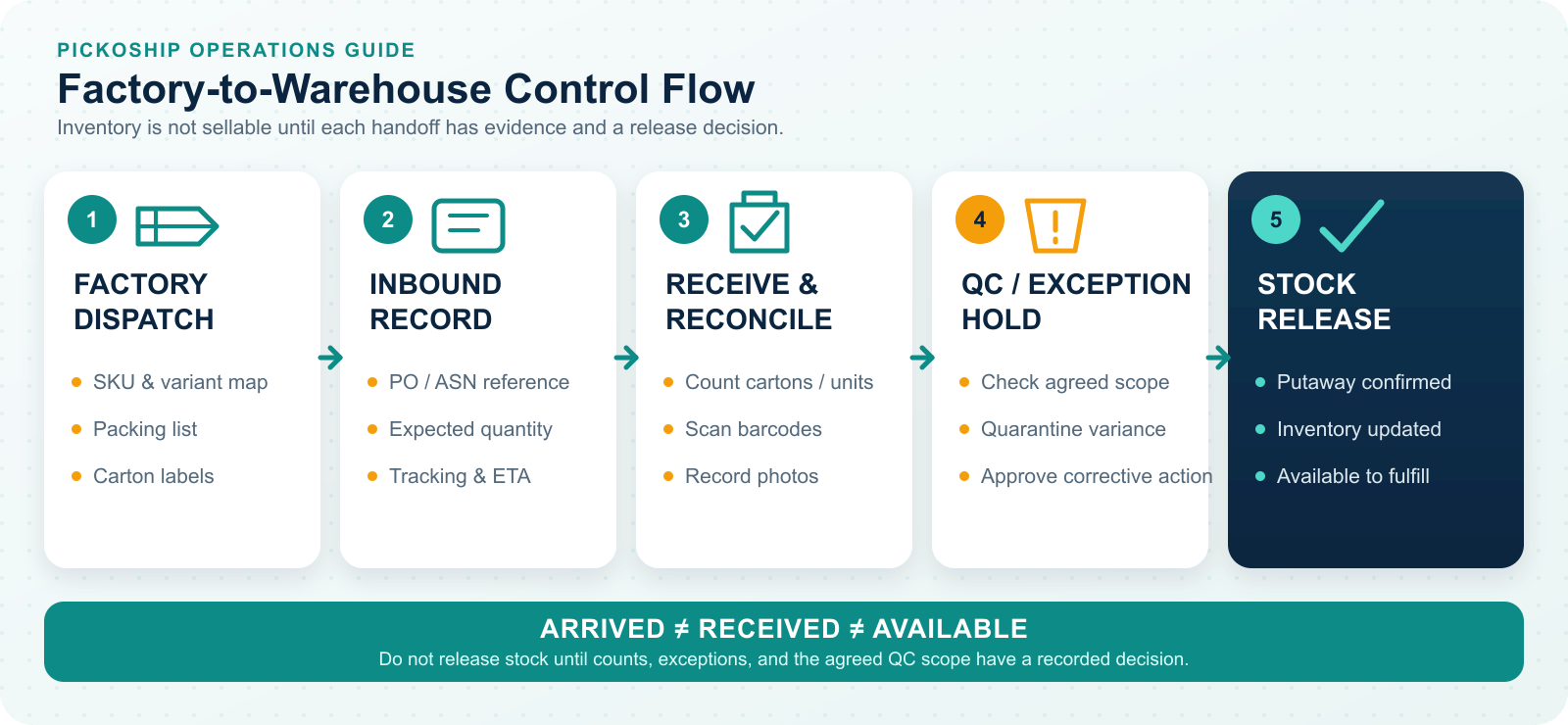
Arrived, Received, and Available Are Different Events
These terms are often used interchangeably, but they represent different risks.
Arrived
The carrier or factory has handed the shipment to the warehouse. At this point, the warehouse may know only the number of cartons and the inbound reference. The contents may not yet have been counted, inspected, or connected to the brand’s inventory account.
Received and reconciled
The warehouse has matched the shipment to an expected inbound record, identified the SKUs, recorded quantities, and documented differences. Some units may still be in a damage, discrepancy, labeling, or QC hold.
Available to fulfill
The approved units have been put away, assigned to the correct inventory owner and SKU, and released into the stock status used for order allocation. Only this quantity should feed the sellable inventory decision.
This distinction is consistent with how ecommerce inventory systems treat transfers and receiving. Shopify, for example, documents that transferring inventory to a destination does not by itself make the product sellable there; stocking or activation is a separate step.
What to Send Before the Factory Dispatches
The cheapest time to correct an inbound error is while the goods are still at the factory. Give the warehouse a usable pre-alert, and give the factory the warehouse’s receiving instructions.
Your inbound record should include:
- brand or inventory owner;
- factory or supplier name and contact;
- purchase order or production reference;
- unique inbound or ASN number;
- destination warehouse and contact;
- estimated dispatch and arrival dates;
- carrier, tracking numbers, or local freight reference;
- carton or pallet count;
- SKU, variant, barcode, and expected quantity;
- lot or expiry data when relevant;
- packed weight and dimensions when required;
- product attributes that affect handling or shipping eligibility;
- packing list, commercial or transport documents when applicable;
- agreed receiving, count, photo, and QC scope;
- the person authorized to decide a discrepancy or QC hold.
An ASN does not need to be complicated software. For a smaller brand, it may be a structured warehouse record created from a controlled template. What matters is that the physical shipment and the expected data share a unique reference before the cartons arrive.
For logistic units that use GS1 standards, an SSCC can uniquely identify a carton or pallet and connect a scan to the despatch advice or ASN. That can reduce manual identification, but it should be implemented only when the brand, factory, and warehouse can all maintain the data correctly. A random barcode that no system recognizes is decoration, not control.
Give the Factory a Packing and Labeling Handoff
Do not send the factory a warehouse address and assume the rest is obvious. The person packing the goods needs a short, visual instruction sheet.
At minimum, specify:
- Carton identity: brand, supplier, inbound reference, carton number, and destination.
- SKU identity: SKU or scannable barcode used by the warehouse—not only the factory’s internal model number.
- Quantity: units per SKU and per carton.
- Mixed-carton rule: whether mixed SKUs are allowed and how every layer or inner pack must be identified.
- Variant separation: sizes, colors, plugs, language versions, bundles, and similar-looking products.
- Packing protection: bagging, inner cartons, dividers, moisture protection, or fragile handling where agreed.
- Document position: where the packing list or shipment reference must appear.
- Photo proof: which pack-out, label, seal, or scale photos the brand wants before pickup.
Ask the factory to photograph one completed carton and its label before packing the entire shipment. A five-minute approval at this stage can prevent a warehouse team from manually identifying hundreds of units later.
The 8-Step 3PL Inbound Receiving Process
1. Create the inbound record before departure
The warehouse should know what is coming before the carrier arrives. Create the inbound record, check that the product master exists, and resolve missing SKUs, invalid barcodes, restricted-product questions, or unusual handling requirements.
Do not dispatch yet if: the warehouse cannot identify the inventory owner, the product is not approved for the planned workflow, or the factory has not received final label instructions.
2. Match the physical shipment to the expected record
When the shipment arrives, the warehouse records the arrival time and connects cartons to the inbound reference. Unidentified stock should enter an exception area rather than being guessed into inventory.
For small local shipments from a Chinese factory, there may be no dock appointment or pallet workflow. The control is still the same: every carton needs a traceable connection to the supplier, brand, and inbound record.
3. Check the outer shipment condition
Before opening cartons, record visible crushing, moisture, broken seals, punctures, missing cartons, or other external damage. Photograph the shipping label and affected areas while the shipment condition can still be connected to the handoff.
This is not a full product inspection. It is evidence of the shipment’s condition at arrival and may be relevant to a carrier, supplier, or packaging claim.
4. Verify SKU identity and quantity
Compare what arrived with what was expected. The count method must be defined in advance because “receiving” can mean different things:
- accepting the supplier’s quantity per sealed carton;
- opening selected cartons to verify pack-out;
- counting every inner pack;
- scanning every unit;
- applying a risk-based or agreed sample.
There is no honest universal answer for every product and volume. A sealed, trusted factory carton may use a different method from a first order containing easily confused variants. The brand should know which method is included, what triggers extra work, and whether recounting or relabeling is chargeable.
5. Perform the agreed quality checks
Quantity verification is not the same as QC. A warehouse can receive 1,000 units correctly and still have 1,000 products with the wrong finish.
Define the exact inspection layer:
| Check type | Example | What it does not prove |
|---|---|---|
| Visual receiving check | Obvious damage, color, missing accessory, packaging condition | Hidden defects or regulatory compliance |
| Measurement check | Weight, dimensions, label position | Product performance unless tested |
| Functional check | Power-on, button, closure, simple assembly | Laboratory safety or long-term reliability |
| Sample inspection | Defined units selected from a production lot | That every uninspected unit is defect-free |
| 100% inspection | The agreed checks performed on every unit | That checks outside the written scope were performed |
If a sampling plan is used, document the lot, sample size, defect classes, acceptance criteria, and disposition. References such as the ISO 2859 family can inform an attribute-sampling plan, but saying “AQL inspection” without the actual plan is not enough.
6. Hold and resolve exceptions
A shortage, overage, mixed variant, damaged unit, unreadable barcode, or QC failure should create a recorded exception—not an informal message that disappears in a chat thread.
The record should show:
- affected inbound, carton, SKU, and quantity;
- the expected and observed condition;
- photos or video where useful;
- who was notified and when;
- available actions and estimated cost;
- the person who authorized the decision;
- the final quantity released, reworked, returned, or disposed of.
Do not allow held stock to enter the sellable pool while the brand is deciding what to do.
7. Put away inventory under the correct owner and status
After reconciliation and the required checks, approved units are assigned to the brand, SKU, storage location, and available status. Damaged, held, returned, or unidentified units remain in separate states.
The useful inventory view is not one total. It distinguishes at least inbound, available, reserved, held or damaged, and returned stock. Each adjustment should have a reason and a history that can be reconciled to the receiving record.
8. Test order release before the launch
Before advertising the new stock, place representative test orders. Include the variants most likely to be confused, a bundle if relevant, and at least one destination that matches the launch market.
Verify:
- store order synchronization;
- correct SKU and inventory reservation;
- pick and pack instructions;
- packaging or insert version;
- fulfillment confirmation and tracking write-back;
- the hold path for an invalid address or insufficient stock;
- which team owns a failed integration or route exception.
PICKOSHIP’s stated dispatch-within-24-hours condition applies only to orders that are paid, synchronized, in stock, and have passed the required checks. Product eligibility, route, DDP treatment, and exception fees must be confirmed for the relevant product and destination.
Who Owns Each Part of Receiving?
Receiving works best when the handoff is explicit.
| Responsibility | Brand | Factory or supplier | 3PL warehouse |
|---|---|---|---|
| Approve SKU names, variants and barcode mapping | Primary | Confirm | Validate setup |
| Create or authorize the inbound record | Primary | Supply final data | Confirm acceptance |
| Pack to the approved specification | Approve | Primary | Report non-compliance |
| Apply correct carton and unit labels | Define | Primary | Scan or verify |
| Provide final quantity and tracking | Review | Primary | Match at arrival |
| Record arrival, count and visible damage | Review | Support claim | Primary |
| Perform agreed-scope QC | Define and decide | Respond or rework | Execute agreed checks |
| Decide disposition of held stock | Primary | Advise or remedy | Maintain hold and execute decision |
| Activate approved inventory | Authorize rules | — | Primary |
| Reconcile store and warehouse availability | Review | — | Support system record |
The table is a planning model, not a universal legal allocation. Your written service plan, purchase agreement, shipping terms, and current quotation should control the actual responsibilities.
Exception Matrix: What Should Stop Stock Release?
| Exception | Immediate action | Release condition |
|---|---|---|
| No inbound reference | Isolate and identify the shipment | Brand, supplier and inbound record confirmed |
| Missing or unreadable barcode | Hold affected SKU; photograph and report | Approved relabeling or alternate identification completed |
| Mixed or mislabeled variants | Separate and recount affected units | Correct SKU mapping and quantities approved |
| Shortage or overage | Record expected versus received | Brand accepts adjustment or supplier resolves it |
| External carton damage | Photograph before unpacking; isolate affected cartons | Product condition assessed and approved units identified |
| Agreed QC failure | Quarantine affected lot or units | Written rework, return, disposal or conditional-release decision |
| Restricted or undeclared product attribute | Stop route or order activation review | Written product and route eligibility confirmed |
| Store mapping failure | Block automatic order release | SKU, inventory and tracking test passes |
| Unapproved special work | Quote the corrective task before execution where practical | Brand authorizes cost and scope |
For a provider-wide due-diligence process covering pricing, DDP, SLAs, returns, and exit planning, use the 15-point China fulfillment partner checklist.
How a One-China-Warehouse Model Changes the Inbound Flow
When the factory and fulfillment warehouse are both in China, inventory can move from the factory to the China warehouse without first being split among several overseas fulfillment centers. Multiple suppliers can feed one brand-owned inventory pool, subject to the agreed receiving and consolidation process. Customer orders can then be picked and packed from that pool and sent through product- and destination-eligible international parcel routes.
This model can simplify the first inventory handoff, but it does not remove operational controls. The warehouse still needs accurate product data, receiving instructions, counts, QC decisions, inventory ownership, route eligibility, and exception rules.
PICKOSHIP provides inventory receiving, agreed-scope quality checks, inventory recording, pick and pack, store order connection, tracked international shipping, and product- and destination-specific returns planning. Exact service scope, eligibility, fees, routes, exceptions, and responsibilities are confirmed in a written fulfillment plan and current quotation. Up to 180 days of free storage applies only to qualifying inventory.
For the wider operating model, see The Complete Guide to China Fulfillment. For a worked cost comparison between one China inventory pool and an overseas-stock model, see Landed Cost from China.
A 10-Minute Inbound Readiness Scorecard
Score each line 0, 1, or 2 before the factory ships.
- 0: missing or only verbal;
- 1: documented but not yet tested;
- 2: documented and verified with a sample, screenshot, record, or pilot.
| Readiness check | Score |
|---|---|
| Product, SKU and variant master is approved | /2 |
| Warehouse receiving instructions reached the factory | /2 |
| Inbound reference or ASN exists | /2 |
| Final quantity, carton count and tracking are recorded | /2 |
| Unit and carton labels were checked before pack-out | /2 |
| Count method and discrepancy process are defined | /2 |
| QC scope, sample and acceptance rules are defined | /2 |
| Product and destination restrictions were reviewed | /2 |
| Decision owner for holds and paid rework is named | /2 |
| Inventory activation and test-order gate are defined | /2 |
Interpretation: 17–20 is ready for a controlled inbound; 12–16 needs specific gaps closed; below 12 should not leave the factory without a corrective plan. This score is a practical planning tool, not a certification or guarantee.
Best For / Not For
This process is best for
- DTC brands moving production from a Chinese factory into a fulfillment warehouse;
- brands consolidating inventory from several suppliers;
- catalogs with variants, bundles, inserts, or packaging rules;
- teams preparing a controlled launch or warehouse migration;
- operators who want a documented discrepancy and stock-release trail.
It may need a specialized process for
- temperature-controlled or hazardous products;
- regulated goods requiring laboratory, licensing, or certification work;
- products needing complex assembly, calibration, or technical testing;
- very large pallet, container, retail-routing, or B2B receiving programs;
- any product or destination that has not passed a current eligibility review.
Frequently Asked Questions
What is an ASN in 3PL receiving?
An advance shipping notice tells the warehouse what shipment to expect before it arrives. It normally connects the supplier, inbound reference, expected SKUs and quantities, cartons or pallets, tracking, and relevant documents. The exact fields and format depend on the warehouse.
Does delivered mean the inventory is ready to sell?
No. Delivered normally means the shipment reached the warehouse. The goods may still need to be identified, counted, inspected under the agreed scope, reconciled, put away, and activated as available inventory.
Should a 3PL count every unit?
Not automatically. The method may be sealed-carton acceptance, sample verification, inner-pack count, unit scan, or 100% count. The right method depends on product risk, supplier history, volume, and the commercial agreement. Confirm the included method and extra-work fees before dispatch.
Is inbound receiving the same as quality control?
No. Receiving confirms custody, identity, quantity, and condition under the agreed process. QC may include visual, measurement, functional, sample, or 100% checks. Regulatory compliance and laboratory testing are separate unless explicitly included.
What causes the most avoidable receiving delays?
Missing inbound references, wrong SKU data, unreadable labels, mixed variants, inaccurate quantities, missing tracking, unapproved special handling, and no authorized person to resolve discrepancies are common causes.
Can several Chinese factories send inventory to one warehouse?
Yes, if the warehouse supports supplier-level inbound records, inventory ownership, SKU mapping, consolidation, and exception handling. Each supplier shipment should retain its own traceable inbound reference even when approved stock later joins one brand inventory pool.
What should a 3PL receiving quote include?
Ask about standard receiving, count method, carton or pallet handling, labeling, QC, photography, special projects, putaway, storage eligibility, disposal, returns, and discrepancy work. Confirm minimums, exceptions, and which tasks require advance authorization.
Need a Written Factory-to-Warehouse Plan?
Send PICKOSHIP a representative SKU list, supplier location, expected quantities, packaging details, target destinations, and required inspection scope. We will identify the receiving data, factory handoff, stock-release gates, and quotation items that need written confirmation before inventory moves.
Request a Factory-to-Warehouse Receiving Plan →
You can also review PICKOSHIP’s China fulfillment service and global shipping model.
Methodology, Disclosure, and Sources
This article combines current public standards and platform documentation with a buyer-side operating framework for factory-to-warehouse fulfillment. It does not certify a warehouse, replace a service agreement, or guarantee receiving time, inventory accuracy, inspection outcome, customs treatment, or delivery performance.
PICKOSHIP publishes this guide and is itself a China fulfillment provider. Apply the same evidence and release controls to PICKOSHIP and competing providers. PICKOSHIP service statements are first-party information and should be confirmed in a written fulfillment plan, current quotation, and representative pilot.
Sources checked August 18, 2026:
- Shopify Help — Creating and managing inventory transfers
- GS1 — Logistic Label Guideline
- ISO — ISO 28590:2017, sampling procedures for inspection by attributes
- PICKOSHIP — How to Vet a China Fulfillment Partner
Update note: This guide was created on August 18, 2026. Product eligibility, routes, DDP treatment, service scope, fees, and operational cutoffs are time-sensitive and require current written confirmation.