On this page34 sections
Two fulfillment quotes can look almost identical and describe very different operations. One may say “low pick-and-pack fee, DDP included, 5–8 day delivery.” The other explains when inventory becomes sellable, what happens when a carton is short, when the carrier actually takes custody, and who pays when a declaration is rejected. The second quote may look less exciting. It is usually much easier to operate.
This checklist is designed to get you to one of three decisions: reject the provider, run a controlled pilot, or approve a limited launch. It shows what to ask, what evidence is worth seeing, and which gaps should stop an inventory transfer.
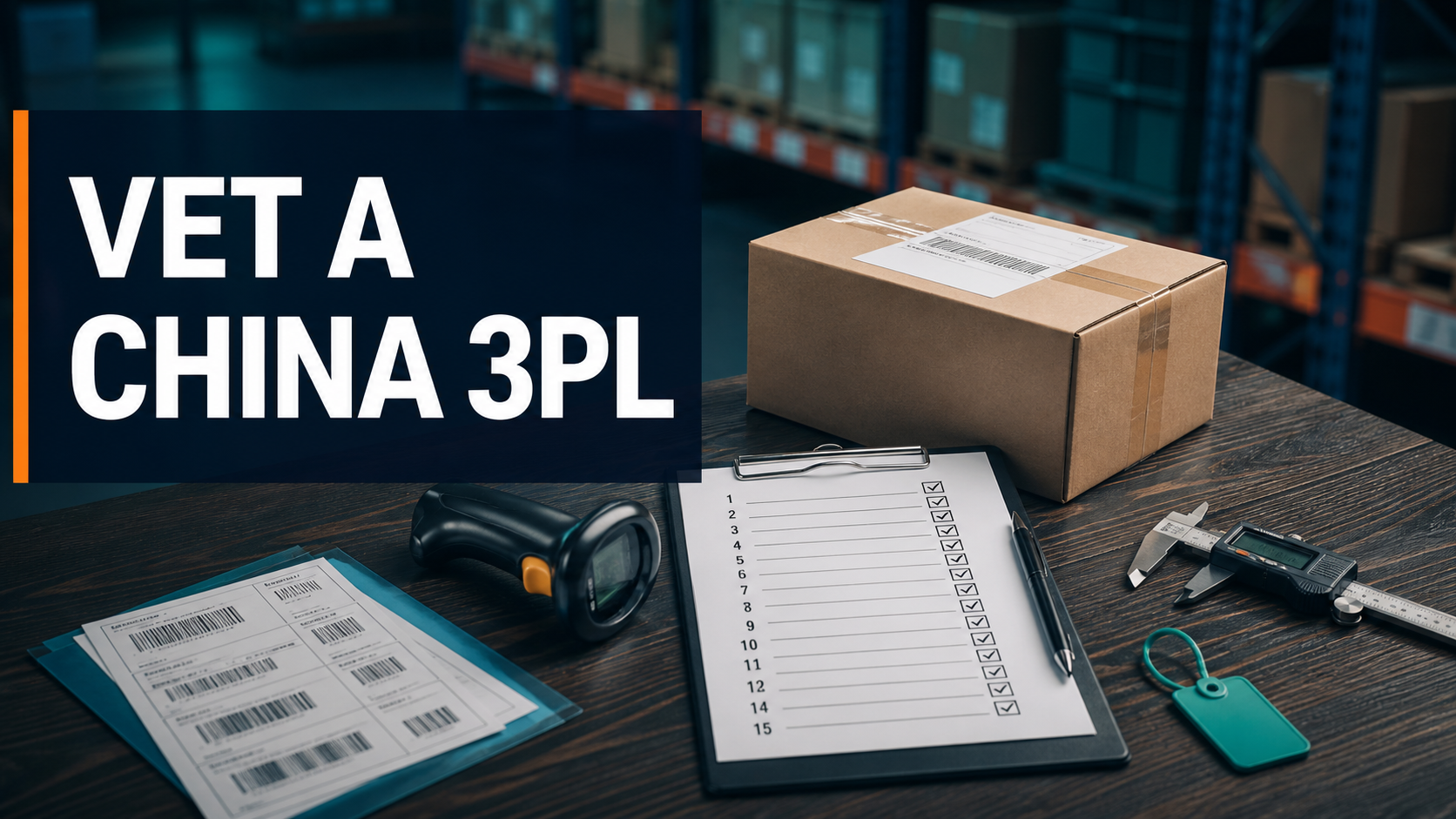
The 15-Point China Fulfillment Partner Checklist
Use the same evidence standard for every provider. A confident answer is useful; a written, product-specific answer that survives a pilot is stronger.
| # | What to verify | Evidence to request | Red flag |
|---|---|---|---|
| 1 | Legal entity and operating model | Contracting entity, warehouse address, service scope, named subcontractors | The sales brand and contracting company cannot be connected |
| 2 | Product and route eligibility | Written review of product attributes, restrictions, documents, and available destinations | “We can ship anything anywhere” |
| 3 | Warehouse custody | Receiving record, SKU location history, discrepancy process | Inventory ownership and location are unclear |
| 4 | Receiving and stock activation | ASN requirements, count method, time-to-available definition | No process for shortages, mixed cartons, or unidentified stock |
| 5 | Quality-control scope | Written inspection plan, sampling or unit scope, defect disposition | “QC included” without checks or acceptance criteria |
| 6 | Inventory accuracy and visibility | Available, reserved, damaged, inbound, and returned stock states | A spreadsheet or portal number cannot be reconciled to physical stock |
| 7 | Pick, pack, and packaging control | Variant scan, bundle logic, packing specification, error workflow | No protection against wrong size, color, bundle, or insert |
| 8 | Dispatch and delivery evidence | Warehouse dispatch definition, carrier acceptance, route-level transit data | One “average shipping time” combines several different clocks |
| 9 | DDP and customs boundary | Written inclusions, exclusions, product eligibility, declaration inputs | “Tax included” with no named destination or product scope |
| 10 | Store integration and exception flow | Test order, tracking write-back, duplicate prevention, manual fallback | Integration is demonstrated only with a marketing screenshot |
| 11 | Returns, rework, and disposal | Destination-specific return options, inspection and inventory rules | “Returns supported” without an address, workflow, or fee schedule |
| 12 | SLA, reporting, and remedies | Defined metrics, reporting period, exclusions, escalation and corrective action | Targets are verbal or have no remedy when missed |
| 13 | Complete pricing structure | Receiving, storage, pick and pack, packaging, QC, shipping, surcharges, returns, minimums | The quote contains only a product price and shipping price |
| 14 | Peak capacity and continuity | Holiday plan, volume limits, backup routes, outage communication | No plan for a product launch, carrier suspension, or warehouse closure |
| 15 | Pilot, contract, and exit plan | Test scope, notice period, data export, stock return or disposal process | The provider pushes a full inventory transfer before a controlled test |
What convincing evidence looks like
Good evidence is specific to the product, route, and account you are evaluating. It has a date, a responsible party, a defined event, and a result you can reconcile later. Examples include an anonymized receiving record, a written QC plan, a route quote with DDP boundaries, a test order with tracking write-back, and an invoice that matches the agreed fee schedule.
A screenshot can support a claim, but it should not carry the entire claim. Ask what event created the data, whether the record can be exported, and how an error would be corrected.
How We Evaluated China Fulfillment Partners
This is a buyer-side due-diligence framework, not a certification standard or a guarantee that a provider will perform well.
The structure follows the major areas buyers are advised to examine when selecting a 3PL: operational fit, technology fit, cost fit, written service levels, inventory visibility, returns, and exception handling. Shopify’s current 3PL guidance recommends getting peak performance and SLA commitments in writing, checking inventory and order-status synchronization, and comparing the full fee structure rather than one headline rate.
For specific technical concepts, this guide also refers to:
- the GS1 Global Traceability Standard for recording traceable inventory events;
- ISO 28590:2017 as an introduction to attribute-based acceptance sampling—the basis behind many AQL-style inspection plans;
- the International Chamber of Commerce’s DDP definition for the allocation of transport, customs, duty, and risk responsibilities;
- Shopify’s 2026 guide to choosing an ecommerce 3PL and warehouse audit checklist.
Publisher disclosure: PICKOSHIP publishes this guide and is itself a China fulfillment provider. Apply every check in this article to PICKOSHIP as well as to any competing provider. PICKOSHIP service descriptions are first-party statements and should be confirmed in a written plan, a current quote, and a pilot using your products and destinations.
1. Confirm Who Actually Controls the Operation
“China fulfillment partner” can describe several different business models:
- a company operating its own warehouse;
- an agent renting space inside another warehouse;
- a software platform routing orders to third parties;
- a sourcing company adding fulfillment through subcontractors;
- a freight forwarder that can arrange storage and parcel dispatch.
None of these models is automatically good or bad. The risk comes from not knowing who is responsible at each handoff.
Start with the agreement, not the sales deck. Identify the legal entity signing it, the physical stock location, the party supervising warehouse staff, the party booking the carrier, and the person who owns a held, lost, damaged, returned, or incorrectly billed order. If subcontractors are involved, the primary provider should still define which responsibilities stay with it.
Evidence to request: a contract showing the service entity, the operating address, the defined service scope, escalation contacts, and any material subcontracting that changes custody or responsibility.
2. Check Product and Route Eligibility Before Comparing Rates
A route that works for a standard cotton T-shirt may not accept a battery, liquid, powder, magnet, cosmetic, food item, medical product, branded good, or oversized parcel. A provider can have a strong route to one market and no compliant option for the same product in another.
Send the provider enough data to make a real eligibility decision:
- product name and intended use;
- materials and composition;
- packed weight and dimensions;
- battery, liquid, powder, magnet, aerosol, or other special attributes;
- selling or declared value;
- target countries and representative postcodes;
- required delivery promise;
- relevant product or transport documentation.
Do not compare rates until each provider confirms the same product, destination, service level, and customs scope. Otherwise, the cheaper quotation may simply exclude the hard part.
3. Verify Warehouse Custody and Receiving Controls
The first operational test is not shipping. It is whether the provider can receive your inventory without losing the connection between the physical units and the digital record.
A proper inbound process should define:
- what information must be sent before arrival;
- how cartons, SKUs, and quantities are identified;
- how received quantity is compared with the advance notice or purchase order;
- how shortages, overages, damage, and mixed cartons are reported;
- when stock becomes available for sale;
- where evidence such as photos, count records, and discrepancy notes is stored.
An anonymized receiving record is more useful than a portal total and safer than a screenshot exposing another customer’s data. It should show the stock event: what arrived, what was counted, what differed, who reviewed it, and what happened next.
This matters because a dashboard can display a precise number and still be wrong. The provider must be able to connect that number to receiving, putaway, allocation, picking, return, adjustment, and disposal events.
4. Define Quality Control Instead of Accepting “QC Included”
Quality control is a scope, not a yes-or-no feature.
A receiving count checks quantity. A visual check may identify obvious color, finish, packaging, or physical damage. A functional test verifies whether a product operates. A measurement check compares dimensions or weight with a specification. A lot inspection uses a documented sampling plan. Laboratory or certification work is different again.
Before stock arrives, define:
- the approved product specification or reference sample;
- which defects are critical, major, or minor;
- whether inspection is per unit, sampled by lot, or triggered by risk;
- which measurements, functions, accessories, labels, and packaging are checked;
- what evidence is recorded;
- who decides whether stock is released, reworked, returned, or disposed of;
- what each additional operation costs.
If a provider mentions “AQL inspection,” ask which sampling plan, inspection level, lot size, and acceptance criteria apply. ISO 28590 introduces the ISO 2859 family of attribute-sampling systems, but citing the acronym alone does not create a complete inspection plan.
Red flag: the provider promises that every product receives “strict QC” but cannot describe what is checked or what happens when a defect is found.
5. Test Inventory Accuracy and Visibility
For a DTC brand, the useful inventory number is not just “stock on hand.” You need to know which units are:
- inbound but not yet available;
- available for sale;
- reserved for paid or held orders;
- in QC hold or damaged status;
- being reworked or relabeled;
- returned and awaiting inspection;
- unavailable for another documented reason.
Find out how quickly each warehouse event updates the client portal and connected store. A stock adjustment should have an approver, a reason, and an exportable history—not simply a new total.
During the pilot, begin with known quantities. Reconcile the physical receipt, the warehouse system, the store inventory, the picked orders, and the final balance. A small discrepancy found during a pilot is more useful than a large discrepancy discovered after a product launch.
GS1’s traceability guidance emphasizes recording events as goods move through business processes. You do not need a complex enterprise system for a small catalog, but you do need a reliable chain from receiving to final disposition.
6. Stress-Test Pick, Pack, and Brand-Control Workflows
Picking errors often happen at the variant and bundle level, not at the product-title level. A warehouse may ship the correct T-shirt style but the wrong size; the correct device but the wrong plug; or two individual items instead of the approved bundle.
Trace how the provider prevents these errors:
- Are SKU or barcode scans required at picking and packing?
- How are sizes, colors, country plugs, and language versions distinguished?
- Can the system enforce bundle contents and subscription-box configurations?
- How are branded inserts, thank-you cards, labels, and packaging versions assigned?
- Is packed weight compared with an expected range?
- What happens when packaging material runs out?
- How are wrong-item or missing-item claims investigated?
Provide a written packing specification with photos or diagrams. During the pilot, order the variants most likely to be confused rather than testing only the easiest SKU.
7. Separate Warehouse Dispatch From Carrier Transit
“Seven-day shipping” can refer to several different clocks:
- order received to warehouse release;
- warehouse release to carrier acceptance;
- carrier acceptance to destination delivery;
- total customer order to delivery.
If a provider combines these into one average, you cannot identify whether a delay occurred inside the warehouse, during carrier handoff, in customs, or in the final mile.
Route-level data should clearly define:
- the starting event and ending event;
- the observation period;
- destination countries or postcode groups;
- product and service eligibility;
- sample size where available;
- median or P50 and a slower percentile such as P90 where available;
- exclusions such as invalid addresses, remote areas, customs holds, restricted products, and peak periods.
If the provider does not publish percentile data, test the actual route and record each timestamp. A provider’s marketing range proves what it states publicly; it does not independently prove future performance for your SKU.
8. Put DDP and Customs Responsibility in Writing
The International Chamber of Commerce defines Delivered Duty Paid as placing the greatest transport and customs responsibility on the seller side: the seller bears the costs and risks to the named destination and handles export and import clearance and duty obligations.
In ecommerce parcel quotations, however, providers may use “DDP line” as shorthand for a particular shipping service. You still need to know exactly what the quoted amount includes.
For every proposed DDP route, confirm:
- the named destination and eligible countries;
- the product classification and declared-value inputs;
- international transportation and final-mile scope;
- customs-clearance handling;
- which duties or taxes are included;
- whether any tax, advancement, remote-area, address-correction, return, or re-delivery charge remains possible;
- who supplies documents and who responds to a customs request;
- what happens if the product or declaration is rejected.
“DDP” does not mean every product qualifies, every destination is available, or no exception charge can ever occur. The written quotation and carrier rules control the actual boundary.
For a worked example of how a DDP parcel should be compared with an overseas-stock model at the same delivered-order endpoint, see PICKOSHIP’s landed-cost comparison.
9. Test the Store Integration With Exceptions, Not Just a Normal Order
An integration is not complete merely because a paid Shopify order appears in a warehouse portal.
Test the full event sequence:
- order import;
- SKU and variant mapping;
- inventory reservation;
- address validation or hold;
- duplicate-order prevention;
- cancellation before dispatch;
- insufficient-stock handling;
- fulfillment confirmation;
- tracking-number and carrier write-back;
- partial fulfillment or split order;
- refund or return status where supported;
- manual fallback if the connection fails.
The real integration owner becomes visible when an event goes missing. If middleware or a third-party connector is involved, document which company investigates the failure and what information each party needs. Otherwise, the warehouse, app, and store platform can each point at the other while the order remains stuck.
Shopify’s 3PL selection guidance recommends checking whether inventory counts, order status, tracking, returns, reporting, and custom API requirements are actually supported. A live test is stronger than an integration-logo grid.
10. Define Returns and Exception Handling Before the First Shipment
The normal order is only half the service. Before launch, decide how the provider handles:
- address errors;
- cancellation after picking but before carrier acceptance;
- failed or refused delivery;
- damaged parcel;
- wrong or missing item;
- carrier loss;
- customs return;
- customer return;
- rework, relabeling, consolidation, restock, disposal, or supplier return.
A global fulfillment provider may not offer a local return address in every market. That is not automatically a reason to reject the provider, but it changes the economics and customer policy. For lower-value items, refund-without-return or local disposal may cost less than returning a parcel internationally. For high-value products, inspection and restock may be essential.
Require a destination- and product-specific return plan rather than a generic “returns supported” promise.
11. Convert Service Promises Into Measurable SLAs
A useful service-level agreement defines the event, target, exclusions, reporting source, escalation path, and corrective action. “Ships within 24 hours” is not measurable until the agreement states which orders qualify, when the clock starts, and what counts as handover.
At minimum, discuss:
| SLA area | Definition to agree |
|---|---|
| Receiving | Arrival event, correct-document conditions, count and shelving target |
| Inventory accuracy | System states included, reconciliation method, adjustment approval |
| Pick accuracy | Order, line, or unit basis; variant and bundle treatment |
| Dispatch | Eligible order definition, cut-off, risk holds, carrier-handover event |
| Tracking | Time from carrier handover to first usable scan or write-back |
| Support | Severity levels, business hours, initial response, escalation |
| Claims | Evidence required, filing deadline, decision process, remedy |
Shopify advises buyers to get order-speed, accuracy, inventory, peak-capacity, and corrective-action commitments in writing. The target number matters, but the definition matters just as much.
12. Compare the Complete Cost Structure
Never compare one provider’s pick-and-pack fee with another provider’s all-in delivered parcel price.
Compare a line-by-line quote using the same product and endpoint:
| Cost area | Questions to ask |
|---|---|
| China inbound | Supplier delivery or warehouse pickup? Carton, distance, or shipment minimum? |
| Receiving | Count, putaway, labeling, discrepancy handling, minimum fee? |
| QC | What checks are included? Per unit, lot, labor time, photo, or report fee? |
| Storage | Unit, bin, shelf, carton, pallet, CBM, or day? Free period and long-stay rules? |
| Pick and pack | First unit, additional item, bundle, insert, packaging, label? |
| Packaging | Standard materials included? Custom packaging production and storage? |
| Shipping | Actual or chargeable weight? Fuel, peak, remote-area, address, return charges? |
| Customs | DDP, DAP, duty, tax, clearance, declaration, advancement, rejected-entry treatment? |
| Returns and rework | Receipt, inspection, restock, relabel, disposal, consolidation? |
| Account terms | Subscription, deposit, minimum spend, currency conversion, top-up or withdrawal? |
Then calculate delivered cost per successful order, not only warehouse cost or shipping cost. Add an exception allowance based on your own address-error, failed-delivery, damage, return, and reshipment history.
For an expanded cost model, use the PICKOSHIP landed-cost guide and request a product-specific quote before making a decision.
13. Ask How the Operation Behaves Under Pressure
Peak capacity is not a warehouse-size claim. It is the ability to preserve defined service levels when order volume, inbound receipts, packaging work, and carrier constraints arrive at the same time.
For the planned launch, pin down:
- the volume assumptions behind your proposed workflow;
- how you should notify them of a product launch or promotion;
- order cut-offs during holidays and peak periods;
- labor and packing-station contingency;
- alternate routes when a carrier line is suspended;
- how restricted or held orders are separated from normal orders;
- backup access to order and inventory data;
- how customers are notified of a material disruption.
Do not accept a statement such as “we can handle any volume” without a scoped launch plan. Your goal is not to discover the provider’s theoretical maximum. It is to understand what happens to your orders when the plan is stressed.
14. Run a Representative Pilot Before Moving Production Inventory
A good pilot tests the actual operating plan, not a specially prepared demonstration parcel.
Include:
- a standard SKU and the variants most likely to be confused;
- custom packaging or insert logic if it will be used in production;
- your core destination plus a second market or postcode type;
- a normal paid order;
- an address hold or correction;
- a cancellation before dispatch;
- an inventory or QC exception;
- tracking write-back;
- a return, rework, or claims walkthrough where practical.
Record these events:
| Pilot event | What to measure |
|---|---|
| Inbound arrival | Units expected, units received, discrepancy evidence |
| Stock activation | Time to counted, checked, shelved, and sellable |
| Order import | Correct store, SKU, variant, quantity, address, payment state |
| Pick and pack | Correct contents, packaging version, label, packed weight |
| Dispatch | Eligible-order timestamp to documented carrier handover |
| Tracking | First usable scan and successful store/customer update |
| Delivery | Carrier transit and total order-to-delivery time |
| Exception | Response time, ownership, evidence, resolution, extra charge |
| Invoice | Quoted lines versus billed lines and unexplained variance |
| Inventory | Final physical/system/store reconciliation |
Choose the pilot size based on SKU, route, and operational risk. A fragile product, regulated item, large variant catalog, or several destination markets needs broader testing than one standard lightweight parcel. The important point is coverage: every material workflow in the planned launch should appear at least once.
15. Agree the Exit Plan Before You Need It
A provider relationship can end because of performance, business change, route loss, pricing, product discontinuation, or a move to a hybrid or destination-warehouse model. Exiting should not require rebuilding your inventory history from screenshots.
Before signing, document:
- contract term and notice period;
- outstanding-balance and refund rules;
- downloadable order, tracking, inventory, adjustment, and billing data;
- stock count and reconciliation at exit;
- packaging-material ownership;
- stock return, transfer, consolidation, or disposal options;
- fees and timelines for removal;
- treatment of open orders, claims, and returns;
- store-integration disconnection and data access.
Refusal to discuss exit is a warning sign. A strong provider should be able to describe both onboarding and offboarding clearly.
A Simple 30-Point Provider Scorecard
Score each of the 15 checks from 0 to 2:
- 0 — Unverified: no answer, contradictory answer, or marketing claim only.
- 1 — Partly verified: general policy or demonstration exists, but it is not specific to your SKU, route, account, or contract.
- 2 — Verified for the decision: written, product-specific evidence exists and is confirmed in the contract, quote, system test, or pilot.
Maximum score: 30.
| Score | Suggested decision |
|---|---|
| 25–30 | Eligible for a controlled launch if no critical gap remains |
| 18–24 | Resolve named gaps and repeat the affected pilot steps |
| 0–17 | Do not move meaningful inventory yet |
This threshold is a PICKOSHIP editorial framework, not an industry standard. Do not let a high total compensate for a critical failure.
Treat the score as a decision aid, not a badge. A provider at 26/30 may be ready for a limited launch; another provider with the same total may still need to be rejected because the missing four points concern custody or customs responsibility.
Automatic hold conditions: unclear inventory custody; no written fee structure; no product/route eligibility review; undefined DDP scope; no inventory reconciliation; no exception owner; refusal to run a representative pilot; or no practical way to export data and remove stock.
Best For / Not For: When a China Fulfillment Partner Fits
A China fulfillment partner may be a strong fit when:
- your products are sourced or manufactured in China;
- you want one inventory pool to serve several supported markets;
- your catalog contains many variants or new SKUs that are difficult to pre-position by country;
- you need receiving, QC, branded packaging, and order fulfillment coordinated near the supply base;
- your products qualify for economical tracked cross-border routes;
- your customers accept the tested delivery promise.
A destination warehouse or hybrid model may be stronger when:
- a stable hero SKU needs very fast domestic delivery;
- the product is heavy or bulky enough that cross-border parcel economics are weak;
- returns are frequent and local inspection or resale is important;
- a marketplace or retail partner requires local inventory and strict domestic SLAs;
- the product or destination lacks a compliant cross-border route.
The decision can be made by SKU rather than by company. A brand may keep long-tail or test inventory in China while moving proven high-velocity products closer to customers.
For the model comparison, review Global DDP Shipping from One China Warehouse and The Complete Guide to China Fulfillment.
Apply the Checklist to PICKOSHIP
PICKOSHIP’s public China fulfillment page describes receiving, agreed QC, inventory recording, pick and pack, store connection, tracked shipping, returns planning, and published service targets. It also states important limitations: the 180-day free-storage window applies only to qualifying inventory; the 24-hour dispatch target applies to eligible paid, in-stock orders after sync and risk checks; and route availability, DDP scope, product restrictions, exceptions, and fees must be confirmed in writing.
Those public statements are a starting point, not a substitute for due diligence. Send your SKU, packaging, order-volume, and destination data. Require a written plan and apply the same 15 checks above.
Need a Written Fulfillment Review?
Share your products, current inventory status, destinations, order volume, packaging requirements, and delivery promise. PICKOSHIP will identify the information needed to define receiving, QC, storage, pick and pack, routes, DDP scope, exceptions, and quote boundaries.
Frequently Asked Questions
What is the most important question to ask a China fulfillment partner?
Ask the provider to show how one real order moves from inbound receipt to inventory, pick and pack, carrier handover, tracking, delivery, and exception resolution. This exposes ownership, system visibility, timing, and hidden handoffs better than asking only for a shipping rate.
Should I visit the warehouse before signing?
A visit can help confirm the physical operation, but it does not prove ongoing inventory accuracy, route performance, or billing. If a visit is not practical, request a live walkthrough focused on receiving, storage, picking, packing, and exception areas, then validate the workflow with records and a controlled pilot. A polished video alone is not enough.
Is an AQL inspection the same as checking every order?
No. AQL normally refers to an acceptance-sampling approach applied to a lot under a defined plan. Per-order visual checks, functional tests, measurements, and laboratory tests are different scopes. The provider should document which inspection applies, what is checked, and how defects are handled.
What should a DDP shipping quote include?
It should identify the product and route, named destination, transportation scope, customs-clearance responsibility, included duty or tax treatment, declaration inputs, eligibility limits, and possible exception charges. Do not assume the label “DDP” makes every product or destination eligible.
How many test orders should a pilot include?
There is no universal number. The pilot must cover the risks in your actual launch: important variants, packaging versions, core routes, and exception flows. A simple one-SKU, one-country operation may need fewer cases than a multi-market catalog with bundles, batteries, liquids, fragile goods, or custom work.
When should I use a US or EU 3PL instead of China fulfillment?
A destination 3PL can be stronger for stable, high-volume products that need fast domestic delivery, heavy items, high-return categories, or marketplace programs requiring local inventory. China fulfillment is often stronger for multi-market tests, broader SKU ranges, and inventory that benefits from remaining close to the supply base. A hybrid model can use both.
Sources and Verification Notes
- Shopify — 3PL in Ecommerce: How to Choose the Right Partner (2026)
- Shopify — Warehouse Audit Checklist (2026)
- GS1 Global Traceability Standard
- ISO 28590:2017 — Sampling procedures for inspection by attributes
- International Chamber of Commerce — Incoterms and DDP
- PICKOSHIP — China Fulfillment Center for DTC Brands
- PICKOSHIP — Global DDP Shipping from One China Warehouse
- PICKOSHIP — Landed Cost from China
Official standards and platform guidance establish definitions and evaluation principles. PICKOSHIP pages establish what PICKOSHIP publicly states, not independently audited performance. Provider capabilities, prices, routes, integrations, customs rules, and service terms can change. Verify your current product, destination, quote, and contract, and seek customs, legal, tax, or compliance advice where appropriate.
Last verified: August 15, 2026.