On this page15 sections
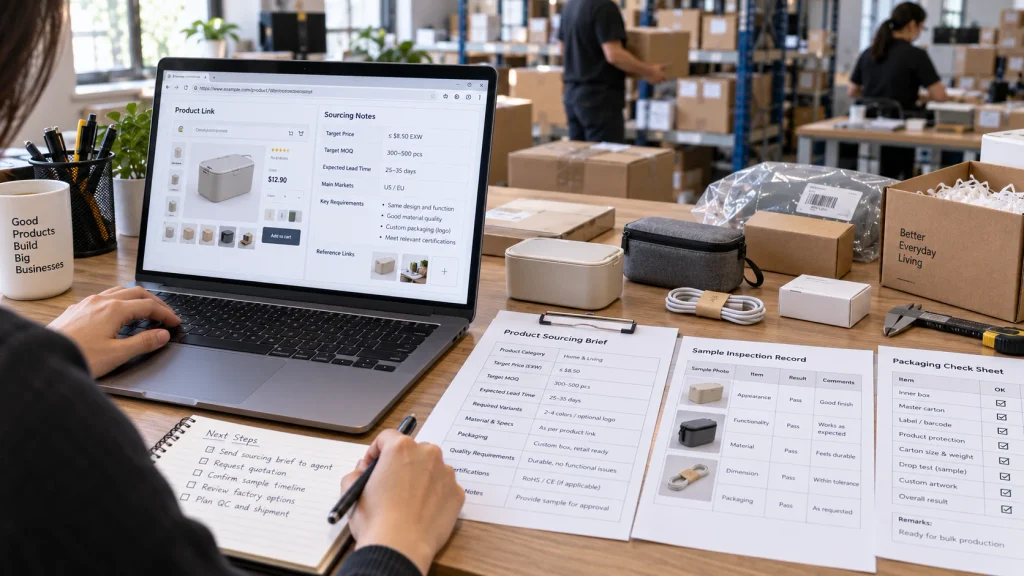
A product link is a useful starting point, but it is rarely an executable sourcing request. A dropshipping agent still needs the relevant variant, quantity, destinations, change limits, and approval points. Turning the link into a structured brief gives the agent something that can be sourced, sampled, and priced without guessing.
The goal is not a long specification before feasibility is known. Separate confirmed requirements from preferences and open questions, then define the evidence you expect back. The result is a working brief that can become an approved specification after supplier feedback and sample review.
Why a Product Link Is Not a Complete Sourcing Brief
Marketplace pages often show a retail presentation rather than procurement information. Images may combine options, titles may hide material or size differences, and the displayed price may exclude packaging, freight, duties, or minimum order conditions. A saved screenshot or product identifier is useful because the page can change.
Treat the URL as source evidence, not an instruction to buy. Tell the agent what to verify: product identity, variants, supplier capability, packed dimensions, sample cost, quality risks, route eligibility, and quote assumptions.
Capture the Exact Product Identity
Start with enough detail to prevent a near-match from being quoted. Record the URL, page title, review date, and a screenshot of the relevant option. Write the product in operational language: intended use, confirmed material, dimensions or size, color, finish, included components, and exact variant or SKU.
List versions separately. A small item, larger item, and bundle should not be collapsed into one line. Ask whether the supplier can keep the selected variant stable and whether a substitute would change the customer promise.
- Must match: the attributes that define the product customers are being promised.
- Useful preference: a desirable finish, insert, bundle, or packaging choice that can change if cost or feasibility requires it.
- Open question: a fact the agent must verify with the supplier, such as composition, accessory compatibility, or carton data.
Add Quantity, Forecast, and Quote Boundaries
A request becomes actionable when the agent can compare commercial scenarios. State the first test quantity, expected monthly range, and whether the number is a forecast or commitment. Suppliers may quote differently for a sample, opening order, and replenishment, so request those scenarios explicitly.
Include a target landed-cost range only as a decision boundary. Ask for line items covering product, customization, packaging, handling, transport, duties or taxes where applicable, and setup costs. Mark estimates that need written confirmation.
Define Destinations, Packaging, and Shipping Constraints
Destination changes the sourcing answer. List primary and secondary markets and any order split. Give the delivery promise as a target until route eligibility and transit assumptions are confirmed. The agent should evaluate packed weight, carton dimensions, category, declared value, and special handling before recommending a route.
Describe the intended customer presentation: retail box, protective mailer, bundle, insert, barcode, or neutral packaging. Call out fragile, liquid, powder, magnetic, battery-powered, oversized, or other sensitive products before quoting. Pickoship’s global shipping guidance notes that eligibility and delivery outcomes depend on the product, packed shipment, destination, route, and operating conditions; those variables belong in the brief.
- Primary and secondary destinations, including any remote-area or marketplace restrictions.
- Packed dimensions and weight, or a request for the agent to measure them during sample or inbound checks.
- Packaging outcome, labeling, inserts, and whether the parcel must remain neutral or branded.
Specify the Sample and Quality Decision
A brief should say what a sample must prove. Separate appearance from functional or fit checks, such as color consistency, finish, dimensions, assembly, packaging protection, or component completeness. If a tolerance or usage test matters, describe the acceptance method instead of asking for good quality.
Ask for sample cost, lead-time estimate, shipping method, useful pre-dispatch photos, and evidence for pre-shipment or inbound inspection. Define the response to failure: revise, resample, compare another supplier, or stop. Pickoship’s product validation workflow emphasizes checking product quality and market assumptions before scaling; your brief should make the quality decision observable.
State What the Agent Must Return
Do not end the request with “Please source this.” List deliverables for the next decision: screened options, comparative quotes, MOQ or volume tiers, samples, packed measurements, route notes, risks, and a recommended next step. Ask the agent to identify assumptions and missing data.
Define approval gates. The agent may research and negotiate within scope, while the brand approves the final specification, claims, substitutions, artwork, and purchase. Record any supplier change as a new brief or specification version before production.
- Sourcing result: supplier identity or description, option differences, MOQ, and commercial assumptions.
- Evidence pack: sample photos, measurements, packaging details, inspection notes, and unresolved risks.
- Decision request: the exact approval or answer needed from the brand before the next step.
A Compact Brief Template
Use this order for a one-page request, then add specification detail after feasibility is established.
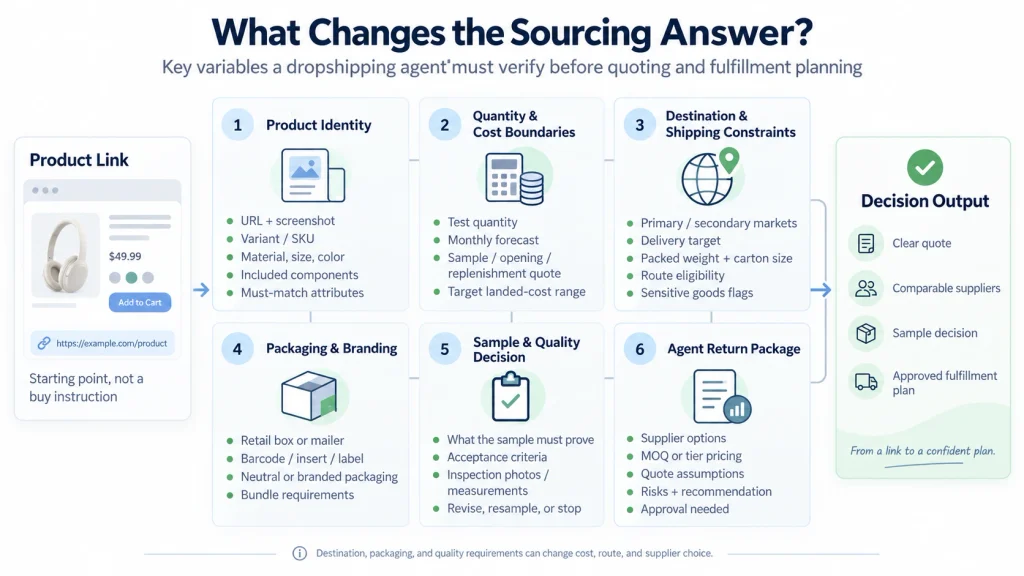
- Product identity: URL, screenshots, product name, variant or SKU, intended use, and must-match attributes.
- Commercial case: test quantity, forecast range, target cost boundary, and whether the request is a quote or a purchase authorization.
- Customization: logo, artwork, insert, packaging, bundle, label, or neutral-packaging requirement; mark each item must-have, preferred, or open.
- Fulfillment: destinations, delivery target, packed data, handling risks, and any channel or address constraints.
- Validation: sample plan, acceptance criteria, inspection evidence, and what constitutes a rejection or revision.
- Return package: supplier options, quote breakdown, assumptions, risks, sample recommendation, and approval needed.
What the Brief Is Not Yet
A sourcing brief is not a purchase order, approved technical drawing, or blanket permission to substitute. Nor does it promise that a marketplace listing can be reproduced exactly. Keep the distinction visible so a preliminary quote does not become a commitment.
Custom branding may require artwork files, packaging dimensions, color references, labeling text, and sample approval. Pickoship describes its private-label process as a sequence from feasibility and specification review to sample approval, production, quality checks, storage, and fulfillment. A disciplined brief supplies each stage with the information it needs.
Where Pickoship Fits
Pickoship may fit when sourcing needs to connect with quality checks, storage, order handling, and cross-border fulfillment. Evaluate whether the proposed flow can preserve the approved variant, capture evidence, and support the required destinations and service scope.
Before purchase, confirm in writing the scope for sourcing, samples, inspection, packaging, storage, order synchronization, routes, returns, exceptions, and fees. For a product-specific review, contact Pickoship with the link, SKU or variant, test quantity, destinations, packed data if available, packaging needs, and target customer promise.
Conclusion
Improve a sourcing conversation by defining the decisions around the link: exact variant, requirements versus preferences, quantities, destinations, packaging, quality evidence, and expected agent deliverables. That turns browsing into a controlled request that can move from quote to sample to approved fulfillment plan.
FAQs
How much information should I send with a product link?
Send the product identity, selected variant, intended use, quantity scenario, destinations, packaging expectations, and the decision you want next. Mark unknown details as questions for verification rather than guessing.
Should I include a target price?
Include one when it is a real decision boundary, and ask for the assumptions behind the quote. A target should not replace a line-item landed-cost view or pressure the agent to hide quality and route trade-offs.
Can the agent approve a supplier on my behalf?
Only within a written authorization scope. Research, comparison, and negotiation can be delegated, but final specification, material substitutions, customer claims, sample release, and purchase authorization should have an explicit owner.
When does the brief become a specification?
It becomes a specification when the product attributes, artwork, packaging, acceptance criteria, and commercial terms are reviewed and approved for the intended SKU and route. Keep version history so later changes are visible.
To request a focused review, send the product link together with the variant, quantity range, destinations, packaging requirements, and any sample or delivery deadline.
Need numbers for your route?
Turn the research into a fulfillment plan.
Share your products, target markets, monthly order volume, and delivery target. We will identify which sourcing, inventory, and fulfillment questions need a verified quote.
No commitment. Route availability, pricing, and delivery times are confirmed in a written quote.