On this page17 sections

Choosing one dropshipping agent or several specialists is not mainly a headcount decision. It is a service-ownership decision. One provider can simplify communication, but a single contact may hide weak backup coverage. Multiple specialists can add expertise, yet every extra handoff creates another place for a product specification, inventory record, order status, or delivery promise to diverge. The workable model is the one that gives each activity a named owner, a controlled input, visible evidence, and a clear escalation path.
Start With the Work, Not the Provider Label
Labels such as agent, sourcing partner, fulfillment center, and quality inspector describe relationships, not necessarily the work. List the services your store needs, from supplier discovery and purchasing to receiving, QC, storage, integration, packing, shipping, returns, and exception response. Then identify which require judgment, physical execution, system access, or brand authority.
A single dropshipping agent is attractive when the product range is focused and the workflow can be managed through one operating plan. Multiple specialists may be justified when inspection, packaging, restricted-goods routing, or destination-market requirements need a capability that the primary provider cannot evidence. The decision should follow the work and its failure cost, not the appeal of a single invoice or a long supplier list.
The Ownership Model: One Lead, Several Executors
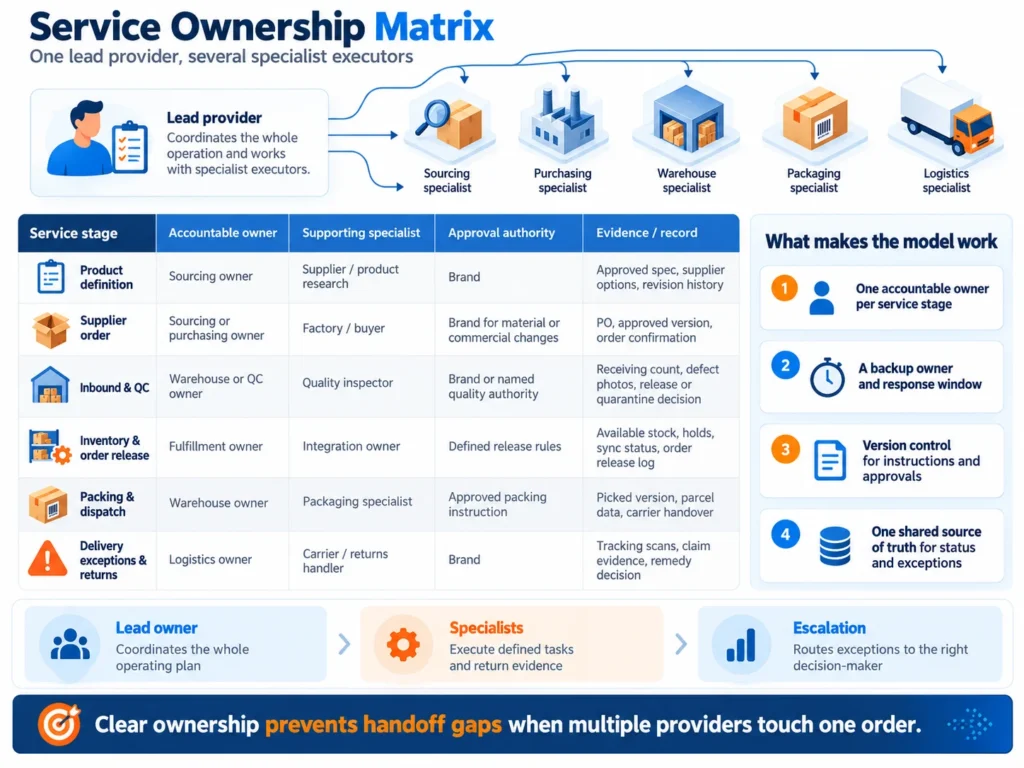
A practical arrangement is often one lead provider with specialist executors. The brand has one accountable service owner, while named specialists perform defined tasks. This preserves an escalation path without pretending one person can execute every operation.
The lead provider must own coordination, not just forward messages. It should maintain the master SKU and packaging versions, inbound references, order status, exceptions, approvals, and service reporting. Specialists return evidence to the shared record. The brand retains product approval, customer promises, market decisions, and nondelegable legal or compliance responsibility.
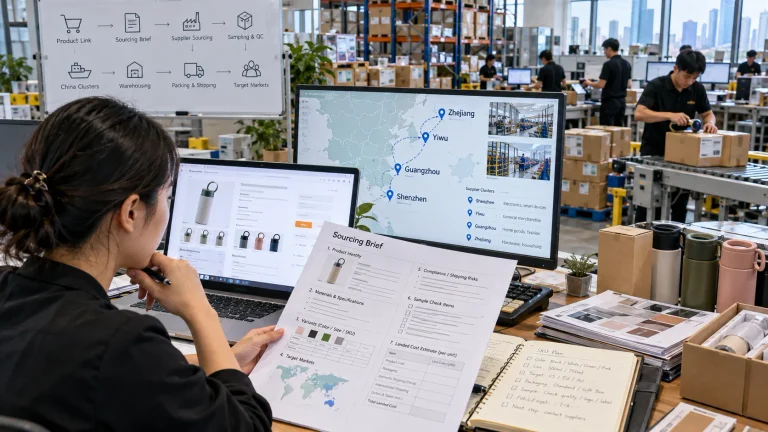
PickoShip presents a useful example of an integrated operating scope: sourcing, quality checks, storage, packing, shipping, and delivery support can be coordinated through one China-based partner. The exact boundary still depends on the SKU, destination, sales channel, order volume, and written plan. The lesson is not that every store needs one provider; it is that the boundary must be explicit.
Assign Ownership Across the Service Chain
Sourcing and Supplier Qualification
The sourcing owner should turn a product brief into comparable supplier options, coordinate samples, and track changes to the approved specification. If several sourcing specialists are used, one party must own the comparison record and final recommendation. The brand should approve the product version, commercial commitment, claims, and material substitutions.
Inbound, Quality, and Inventory Release
The receiving or fulfillment owner should control the inbound reference, expected cartons, SKU quantities, receiving count, inspection status, quarantine decision, and inventory release. The quality specialist may perform checks, but the acceptance rule and disposition authority must be written before stock arrives. PickoShip’s published fulfillment scope covers receiving, agreed QC, inventory recording, and warehouse execution; eligibility and exceptions should be confirmed for the specific product.
Store Integration and Order Release
The integration owner should define which sales channels connect, which order and inventory events sync, how frequently updates are exchanged, and what manual fallback applies when a connection fails. The store integration scope should be tested with paid orders, cancellations, address edits, stockouts, split shipments, and tracking write-back. A lead provider may coordinate the process while a technical specialist maintains the connection. Ownership fails when the store team assumes the warehouse owns a sync error, while the warehouse assumes the platform has released the order correctly.
Packing, Shipping, and Delivery Exceptions
The fulfillment owner should control SKU and quantity picking, approved packaging, parcel data, dispatch evidence, and carrier handover. A packaging specialist may own artwork, inserts, or kitting instructions, but the warehouse needs one approved version to execute. PickoShip’s private-label workflow shows why packaging, labels, inserts, kitting, and fulfillment must be connected rather than treated as separate creative tasks. For transport, separate warehouse processing from carrier transit and define who investigates no-scan events, customs holds, failed delivery, and returns. Route eligibility and DDP assumptions belong in a product- and destination-specific global shipping plan.
A Practical Service Ownership Matrix
For each service row, name one accountable owner, any supporting specialist, the approval authority, and the evidence that closes the task.
- Product definition: brand approves the specification; sourcing owner maintains supplier options and revision history.
- Supplier order: sourcing or purchasing owner places the approved order; brand controls material changes and commercial commitment.
- Inbound and QC: warehouse or QC owner records counts and defects; brand or named quality authority decides release, rework, or rejection.
- Inventory and order release: fulfillment owner records available stock and holds; integration owner maintains event flow and manual fallback.
- Packing and dispatch: warehouse owner records the picked version, parcel details, and carrier acceptance; packaging specialist owns the approved instruction set.
- Delivery exceptions and returns: logistics owner supplies scans and claim evidence; brand decides customer remedy, refund, replacement, or policy change.
The accountable owner should be a role or team, not only a person’s name. Record a backup, response window, and escalation route. Otherwise a multi-specialist model simply distributes responsibility until no one owns the outcome.
When One Agent Is Enough
A single agent or integrated fulfillment partner is usually sufficient when the catalog is focused, suppliers and destinations are manageable, customization is limited, and backup coverage is visible. It fits brands that want sourcing, warehouse execution, and shipping coordinated through one plan. Confirm what the agent controls, what is subcontracted, and how a peak week or absence is handled.
When Multiple Specialists Are Justified
Use multiple specialists when a capability is materially different from the primary workflow: a product requires independent testing, a packaging program needs production oversight, a destination has special routing rules, or a high-volume store needs separate technical and warehouse capacity. The extra provider is worthwhile only when its output has a clear interface. Define the required input, format, deadline, acceptance rule, and receiving owner before work begins.
How to Test the Model Before Going Live
Run a controlled pilot with one representative SKU and at least one difficult scenario. Ask the lead provider to show the complete record, not just a status update. A useful pilot tests:
- Input completeness. Can every provider identify the same SKU, approved version, destination, quantity, and required evidence?
- Decision rights. Who can approve a supplier, release inventory, accept a defect, change packaging, select a route, or issue a customer remedy?
- Handoff timing. What event transfers custody, and how are cutoffs, holds, holidays, and late inputs recorded?
- Exception recovery. What happens when stock is short, a sync fails, a parcel has no scan, or a specialist becomes unavailable?
- Commercial clarity. Which receiving, QC, storage, packaging, shipping, return, and special-operation charges are included or quoted separately?
PICKOSHIP can be assessed as a coordinated sourcing and fulfillment partner when the store wants one operating plan. Share the SKU mix, packaging requirements, destinations, store platform, peak orders, and delivery promise so the written scope can identify what is included and where a specialist or fallback is required.
Conclusion
The choice between one dropshipping agent and multiple specialists is a design problem. One provider can simplify accountability if internal handoffs are visible; multiple specialists can add expertise if a lead owner controls the interfaces and one source of truth. Assign ownership by activity, decision, evidence, and exception path, then choose the smallest model that can handle a difficult week.
Frequently Asked Questions
Is one dropshipping agent always better than multiple specialists?
No. One agent is simpler when the workflow is integrated and the provider has adequate coverage. Multiple specialists are reasonable when a distinct capability is required and the handoff into the lead operating record is controlled.
Who should be accountable when several providers touch one order?
Name one lead service owner for the end-to-end plan. Supporting providers own their task and evidence, while the lead owner manages the interface, escalation, and final operational status.
Can the brand keep product approval while outsourcing execution?
Yes. The brand can retain approval of specifications, claims, packaging versions, customer promises, and remedies while delegating sourcing coordination, warehouse work, and logistics execution under a written scope.
What is the biggest risk in a multiple-specialist model?
The main risk is conflicting records or instructions. Use one master SKU and order record, named owners, version control, evidence requirements, backup contacts, and an escalation rule for every handoff.
To design a service boundary for your products, suppliers, packaging, channels, and destinations, share the expected workload and exception cases, then request a written fulfillment review from PICKOSHIP before appointing or dividing providers.
Need numbers for your route?
Turn the research into a fulfillment plan.
Share your products, target markets, monthly order volume, and delivery target. We will identify which sourcing, inventory, and fulfillment questions need a verified quote.
No commitment. Route availability, pricing, and delivery times are confirmed in a written quote.