
On this page16 sections

A dropshipping agent should own the physical and data execution needed to move an approved order: supplier coordination, receiving, agreed inspection, inventory records, pick and pack, dispatch, tracking, and operational exception evidence. The brand must retain the commercial and legal decisions behind that execution: what may be sold, the product specification, the customer promise, compliance accountability, pricing, refunds, and the final approval of brand standards. The best operating model is not total outsourcing. It is a documented handoff in which each party knows what it can decide, what it must report, and what requires approval.
Why the Ownership Boundary Matters
When responsibility is vague, routine problems turn into expensive debates. A supplier ships the wrong version, but no one can identify who approved the sample. A parcel misses a delivery promise, yet warehouse processing time and carrier transit time were never separated. A customer receives generic packaging because the brand brief was treated as a suggestion rather than a controlled specification. Clear ownership prevents these gaps and gives both teams a practical escalation path.
The boundary should follow control. The party that performs an activity should own its process, records, and timely reporting. The party that bears the market, customer, or regulatory consequence should keep the final decision. This principle applies whether a store uses single-piece dropshipping, stocked fulfillment, or a hybrid model.
The Operating Boundary at Each Order Stage
The order journey contains connected handoffs rather than one continuous outsourced task. A useful operating plan names the input, decision owner, execution owner, evidence, and exception rule at every stage.
Product Definition and Supplier Handoff
The brand owns the sellable-product definition: target customer, approved features, materials, color or size variants, labeling, intellectual-property clearance, destination markets, and acceptable landed cost. The agent can search factories, compare quotations, arrange samples, negotiate terms, and follow production. However, it should not quietly replace a material, accept a different specification, or place a bulk order without the brand’s documented approval. A signed sample, specification sheet, or approved reference set is the control point.
Inbound Receiving and Quality Control
The agent should own receiving records, quantity checks, SKU identification, quarantine status, and the inspection steps agreed before stock arrives. The brand owns the acceptance standard and decides whether a material defect is acceptable, reworkable, refundable, or grounds for supplier rejection. Visual checks do not automatically prove function, certification, or laboratory compliance. Those requirements need a separate test plan, sampling method, evidence format, and approval threshold.
Inventory and Order Release
The agent should maintain accurate warehouse movements, available stock, allocations, and order status. Where supported, the agent should also operate the agreed store integration scope, including order import, fulfillment updates, tracking return, and a manual fallback. The brand still owns demand planning, campaign timing, safety-stock policy, preorder decisions, and the business response to a stockout. A dashboard is evidence of current records, not a substitute for the brand’s forecast.
Pick, Pack, and Brand Presentation
The agent owns picking the correct SKU and quantity, using approved packaging components, applying required labels, and recording packing exceptions. The brand owns the unboxing standard: artwork, claims, inserts, prohibited supplier branding, sustainability choices, and approval of any private-label packaging. Both parties should keep version control. If a branded mailer is unavailable, the agent should pause or use a pre-approved fallback rather than improvise.
Shipping, Tracking, and the Delivery Promise
The agent should recommend an eligible route based on destination, packed weight, product attributes, service level, and current line conditions; hand over parcels; upload tracking; and investigate carrier exceptions. The brand owns the delivery promise shown at checkout and in customer messages. Warehouse processing and carrier transit must be measured separately. Before launch, review current cross-border shipping options and document cut-off times, restricted products, customs assumptions, remote-area charges, and peak-season exceptions.
Exceptions, Returns, and Customer Resolution
The agent should provide operational facts: scan history, packing evidence, inventory adjustments, carrier responses, and the available return, restock, rework, or disposal options. The brand owns customer communication, refund or replacement policy, chargeback handling, and any goodwill decision. Root-cause action is shared. The agent fixes warehouse or supplier-process failures; the brand corrects inaccurate listings, forecasts, or customer promises. Neither side should close a case without recording the cause and preventive action.
A Practical Responsibility Matrix
Use this matrix as a starting point, then adapt it to the product, market, sales channel, and agreed service level.
| Stage | Agent Owns | Brand Retains |
| Product and supplier | Source, compare, sample, negotiate, follow production | Approve specification, claims, compliance path, and purchase |
| Inbound and QC | Receive, count, inspect to the written plan, quarantine exceptions | Set acceptance criteria and decide disposition |
| Inventory and orders | Record movements, process released orders, report discrepancies | Forecast demand, set buffers, authorize preorder or stockout response |
| Packing | Pick correctly and use the approved packaging version | Approve brand assets, inserts, claims, and fallback rules |
| Shipping | Select within approved rules, dispatch, return tracking, investigate | Set checkout promise, customer messaging, and risk tolerance |
| Returns and claims | Supply evidence and execute agreed logistics actions | Decide refund, replacement, customer remedy, and policy changes |
Turn the Boundary Into an Operating Agreement
A responsibility matrix becomes useful only when it is tied to measurable evidence. Before inventory moves, confirm five controls:
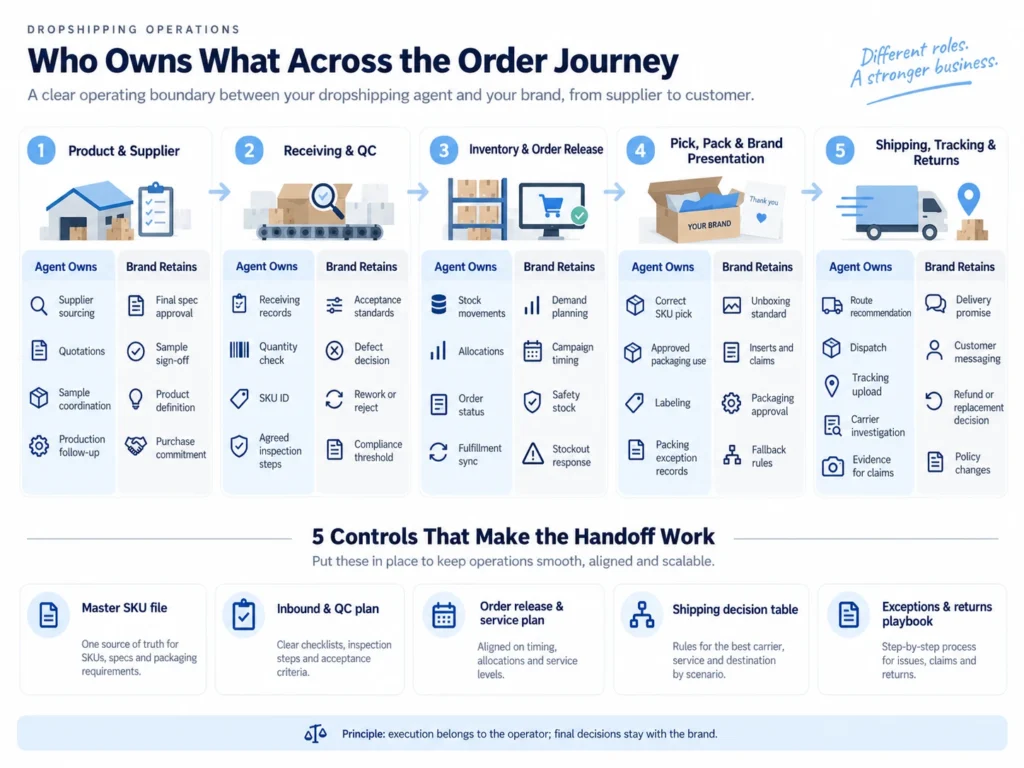
- A master SKU file with approved specifications, barcodes, variants, packaging version, and restricted-product flags.
- An inbound and QC plan that states the sample size, inspection method, acceptance threshold, evidence, and escalation path.
- An order-release and service plan covering cut-off times, eligible in-stock orders, holds, cancellations, address changes, and manual fallback.
- A shipping decision table that separates warehouse processing from carrier transit and defines the allowed routes by product and destination.
- An exception and returns playbook with response times, evidence ownership, claim deadlines, disposition options, and customer-decision authority.
The agreement should also state who may approve substitutions and how approvals are stored. For PickoShip’s order fulfillment operations, published targets are planning inputs rather than universal guarantees; eligibility, cut-offs, product restrictions, special operations, and exceptions belong in the written plan. That qualification is the right model for any agent relationship.
Conclusion
A strong dropshipping agent owns reliable execution and transparent evidence, while the brand keeps control of market-facing decisions and final approvals. The boundary is not about shifting blame. It is about placing each decision with the party that has the information, authority, and consequence. When supplier approvals, QC thresholds, inventory rules, packaging versions, shipping promises, and customer remedies are documented, the order journey becomes auditable and easier to scale.
FAQs
Should a dropshipping agent choose suppliers without brand approval?
The agent can identify, compare, and negotiate with suppliers, but the brand should approve the final specification, sample, commercial terms, and purchase commitment.
Who owns product compliance in dropshipping?
The brand retains accountability for what it sells and the markets it enters. An agent can collect documents and coordinate checks, but evidence and requirements must be verified for the product and destination.
Who should decide the shipping method?
The agent should recommend routes within agreed rules. The brand should approve service levels, cost limits, risk tolerance, and the delivery promise communicated to customers.
What data should the agent report?
At minimum: inbound quantities, inspection exceptions, inventory movements, order status, dispatch time, tracking, carrier exceptions, claim evidence, and return disposition.
To define the handoffs for your SKUs, destinations, packaging, and daily order volume, request a written fulfillment review from PickoShip before moving inventory.
Need numbers for your route?
Turn the research into a fulfillment plan.
Share your products, target markets, monthly order volume, and delivery target. We will identify which sourcing, inventory, and fulfillment questions need a verified quote.
No commitment. Route availability, pricing, and delivery times are confirmed in a written quote.