On this page16 sections

A dropshipping agent does more than find a supplier and book a parcel. The difficult work sits between those visible endpoints: turning an approved product into a controlled purchase, moving finished goods into a verified inventory record, releasing the right order, preserving the approved packing standard, and separating warehouse dispatch from carrier delivery. Each transition is a handoff. If its inputs, approval rules, and evidence are unclear, a small exception can become a stock discrepancy, wrong item, missed promise, or customer dispute. The brand should first define the responsibility boundary; the agent should then make every operational handoff traceable.
Why the Handoffs Stay Hidden
Most dashboards show states such as ordered, received, available, fulfilled, shipped, or delivered. They rarely show the decisions that move an item from one state to the next. A dropshipping fulfillment process may look automatic, but a supplier’s production notice still needs to become a purchase reference, carton count, SKU map, and expected arrival. A paid order still needs valid inventory, an approved address, the correct packaging version, and an eligible route. The transfer works only when those underlying rules have already been defined.
A reliable process therefore treats each handoff as a control point. One party provides a complete input, another accepts custody or execution, and both can later show what happened. The agent’s value is not simply forwarding messages. It is keeping the physical product, system record, approval history, and exception evidence aligned across several organizations.
The Six Operational Handoffs
Approved Product Brief to Supplier Order
The first handoff converts commercial intent into something a supplier can execute. The control packet should identify the approved SKU and variants, specification or reference sample, quantity, packaging requirements, labeling, target markets, agreed price basis, and who may approve changes. A chat message or marketplace link is not enough. If a material, color, accessory, or carton changes, the agent should stop the order at the decision point and obtain documented approval rather than letting production continue on an assumption.
Supplier Completion to Warehouse Receiving
When production is ready, the agent translates supplier output into an inbound receiving plan. The warehouse needs the purchase or inbound reference, supplier name, expected arrival, carton count, SKU quantities, carton labels, packing list, and any inspection instructions. Receiving should record what physically arrived, what differed, and where the goods were placed. Shortages, overages, mixed cartons, or unidentified units should enter an exception status instead of being silently added to available inventory.
Quality Decision to Sellable Inventory
A count confirms quantity; it does not confirm product acceptance. The next handoff requires a written inspection scope, approved reference, sample or unit coverage, defect categories, evidence format, and disposition authority. The agent can perform or coordinate the agreed checks, photograph discrepancies, and quarantine affected stock. The brand should decide whether stock is released, reworked, returned, or rejected. Once released, the approved quantity must become the same sellable quantity in the warehouse record and connected sales channels.
Store Order to Warehouse Release
An imported order is not automatically ready to pick. The release rule should confirm payment status, SKU and variant mapping, available inventory, address quality, cancellation cutoff, fraud or risk holds, and any market-specific instructions. The agent should document the store integration scope, including which events sync automatically, when tracking returns to the store, and what manual fallback applies if the connection fails. This prevents the store, middleware, and warehouse from each assuming another system owns a stuck order.
Packing Proof to Carrier Acceptance
Packing hands the order from warehouse control to transport control. The record should connect the order to the picked SKU, approved packaging version, parcel weight, label, tracking number, route, and carrier acceptance event. A warehouse-created label is not the same as a carrier scan. In a documented China fulfillment workflow, processing time should be measured separately from carrier transit so a late pick, missed collection, customs hold, and final-mile delay do not collapse into one vague shipping complaint.
Tracking Event to Delivery Exception
After carrier acceptance, the agent monitors events rather than controlling every mile. The handoff still needs rules for no-scan parcels, failed delivery, customs questions, address correction, remote-area issues, loss claims, and returns. The agent should supply scan history, carrier responses, deadlines, and available logistics actions. The brand decides the customer remedy and messaging. Current global shipping options should be verified for the product and destination because route eligibility, DDP scope, transit observations, and exceptions can change.
What Every Handoff Record Should Contain
The tools may vary, but each record should answer the same operational questions. A spreadsheet can work for a controlled pilot; a connected system is usually easier at higher order volume. The important point is that the fields are consistent and can be reconciled later.
- Object: the SKU, purchase order, inbound shipment, customer order, parcel, or return being transferred.
- Trigger: the event that permits the next step, such as sample approval, warehouse receipt, stock release, paid-order sync, or carrier scan.
- Owner and deadline: the party responsible for acting and the time or cutoff that applies.
- Approved version: the specification, packaging instruction, route rule, or customer promise that governs the work.
- Evidence: counts, photos, timestamps, scans, weights, tracking events, or written approvals.
- Exception path: the hold status, escalation contact, decision authority, and permitted fallback.
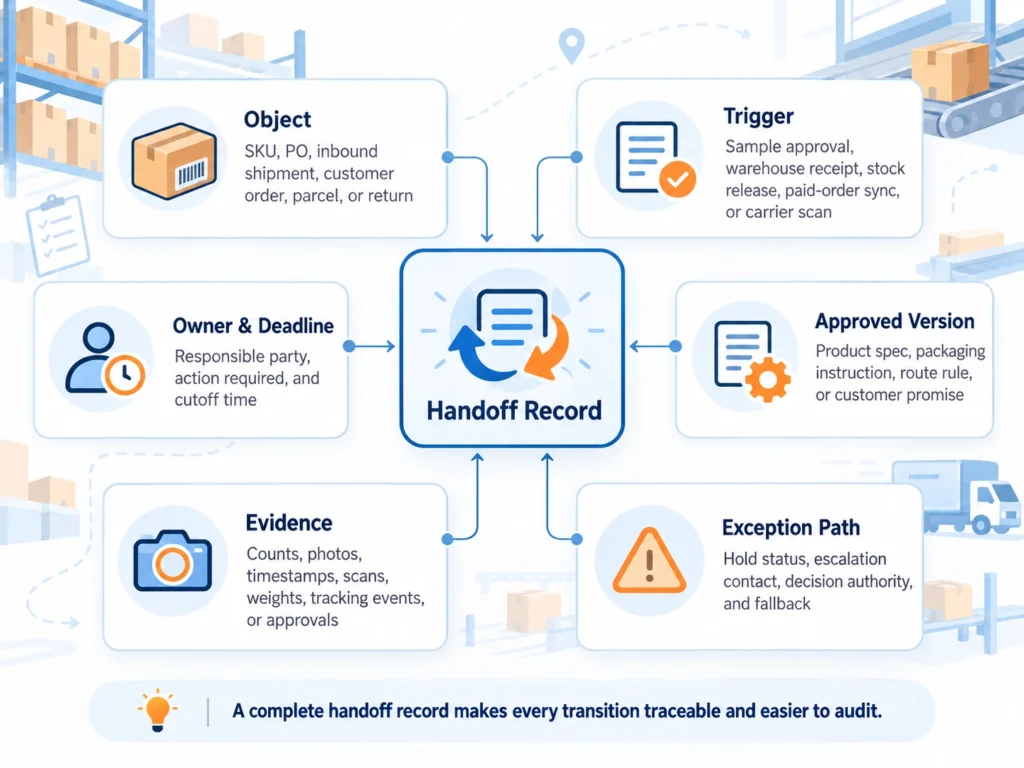
These fields create an audit trail without pretending that every exception can be automated. They also make performance reviews more useful: the team can see whether the failure began with an incomplete input, an unapproved change, a warehouse execution error, a carrier event, or an unrealistic customer promise.
How to Test a Dropshipping Agent Before Go Live
Do not evaluate the workflow only through a normal order. Use one representative SKU and deliberately test the transitions that are most likely to fail. PICKOSHIP combines sourcing, quality checks, storage, packing, order handling, and global dispatch within one operating scope, but the exact service terms still depend on the product, destination, integration, volume, and written plan.
- Run an inbound discrepancy. Send a known carton quantity and confirm how a shortage, overage, or unidentified unit is recorded and held.
- Create a QC exception. Use an agreed defect example and verify the evidence, quarantine status, approval request, and inventory outcome.
- Test a changed order. Check cancellation, address correction, insufficient stock, and duplicate prevention before dispatch.
- Trace one parcel end to end. Capture order release, pick and pack, label creation, carrier acceptance, tracking write-back, and delivery timestamps separately.
- Review the commercial boundary. Confirm receiving, QC, storage, packing, shipping, surcharges, return handling, and special work as separate quote lines where applicable.
Before moving live inventory, ask PICKOSHIP or any prospective agent to show how these records connect for your own SKU. Supplier names, product details, packaging versions, daily order volume, target countries, store platform, and delivery promise are the practical inputs for that review.
Conclusion
The hidden work of a dropshipping agent is the controlled transfer between organizations, systems, and physical states. A good handoff names the object, trigger, owner, approved version, evidence, and exception path. That structure keeps sourcing decisions connected to warehouse reality and keeps dispatch records connected to the customer outcome. When those links are visible, brands can diagnose failures faster, compare providers more fairly, and scale without relying on one person’s memory or chat history.
Frequently Asked Questions
What is the most important dropshipping handoff?
The supplier-to-warehouse handoff is often the first major operational test because it connects the purchase record, physical quantity, inspection scope, and inventory system. If that connection is wrong, later order and shipping data cannot be trusted.
Should an agent approve product changes?
An agent can identify a change and recommend an option, but material, specification, packaging, or commercial changes should follow the authority defined by the brand. The approval and revised version should be recorded before production continues.
When does an order become ready to fulfill?
It becomes ready when the agreed release conditions are satisfied, such as payment status, valid SKU mapping, available stock, acceptable address data, no active hold, and completion of any cutoff or fraud checks defined for the account.
Is label creation the same as shipment?
No. Label creation shows that shipment data was prepared. Carrier acceptance is the stronger custody event. Warehouse dispatch and carrier transit should be tracked as separate intervals so delays can be assigned to the correct stage.
To map these handoffs for a specific product, share the SKU and variant list, supplier status, inspection needs, packaging version, sales channels, daily order volume, destination countries, and delivery promise, then request a written fulfillment review from PICKOSHIP before transferring inventory or live orders.
Need numbers for your route?
Turn the research into a fulfillment plan.
Share your products, target markets, monthly order volume, and delivery target. We will identify which sourcing, inventory, and fulfillment questions need a verified quote.
No commitment. Route availability, pricing, and delivery times are confirmed in a written quote.