On this page36 sections
An AI-generated product page can be ready before lunch. The first refund may arrive three weeks later because the listing says “set of two” while the purchase order covers one unit. A parcel may be rejected because the approved record says “no battery” while the finished product contains a button cell. An ad may keep selling after the supplier’s last usable stock update.
That is not mainly a writing problem. It is a control problem.
AI dropshipping works when fast digital work is connected to verified product data, explicit order states, and a fulfillment process that records what physically happened. It fails when generated answers are allowed to become inventory, pricing, product claims, refunds, or shipping promises without a reliable source and a stop condition.
This guide is for operators who want useful automation—not the illusion of a store that runs itself.
First, Sort Automations Into Green, Yellow, and Red
The practical question is not “Can AI do this?” It is “What happens if it is wrong?”
| Control level | Good candidates | Required control | Examples |
|---|---|---|---|
| Green: assist or draft | Reversible, low-cost work with visible output | Human can review before publication or use | Cluster review themes, summarize supplier quotes, draft FAQ answers, tag tickets, propose ad angles |
| Yellow: automate with limits | Repetitive actions that affect customers, orders, inventory, or spend | Approved source, threshold, hold path, alert, log, and manual override | Sync paid orders, reserve stock, pause low-stock ads, route routine tickets, approve low-risk refunds within a limit |
| Red: keep a human gate | High-impact, hard-to-reverse, safety-sensitive, legal, financial, or physical decisions | Named decision owner and recorded evidence | Approve a supplier or sample, release failed QC, publish objective safety claims, select an unverified DDP route, issue an unusual high-value refund |
This map is intentionally conservative. A task can move from red to yellow after the business has clean data, a stable process, enough exception history, and a safe rollback. It can also move back when the supplier, product, market, or system changes.
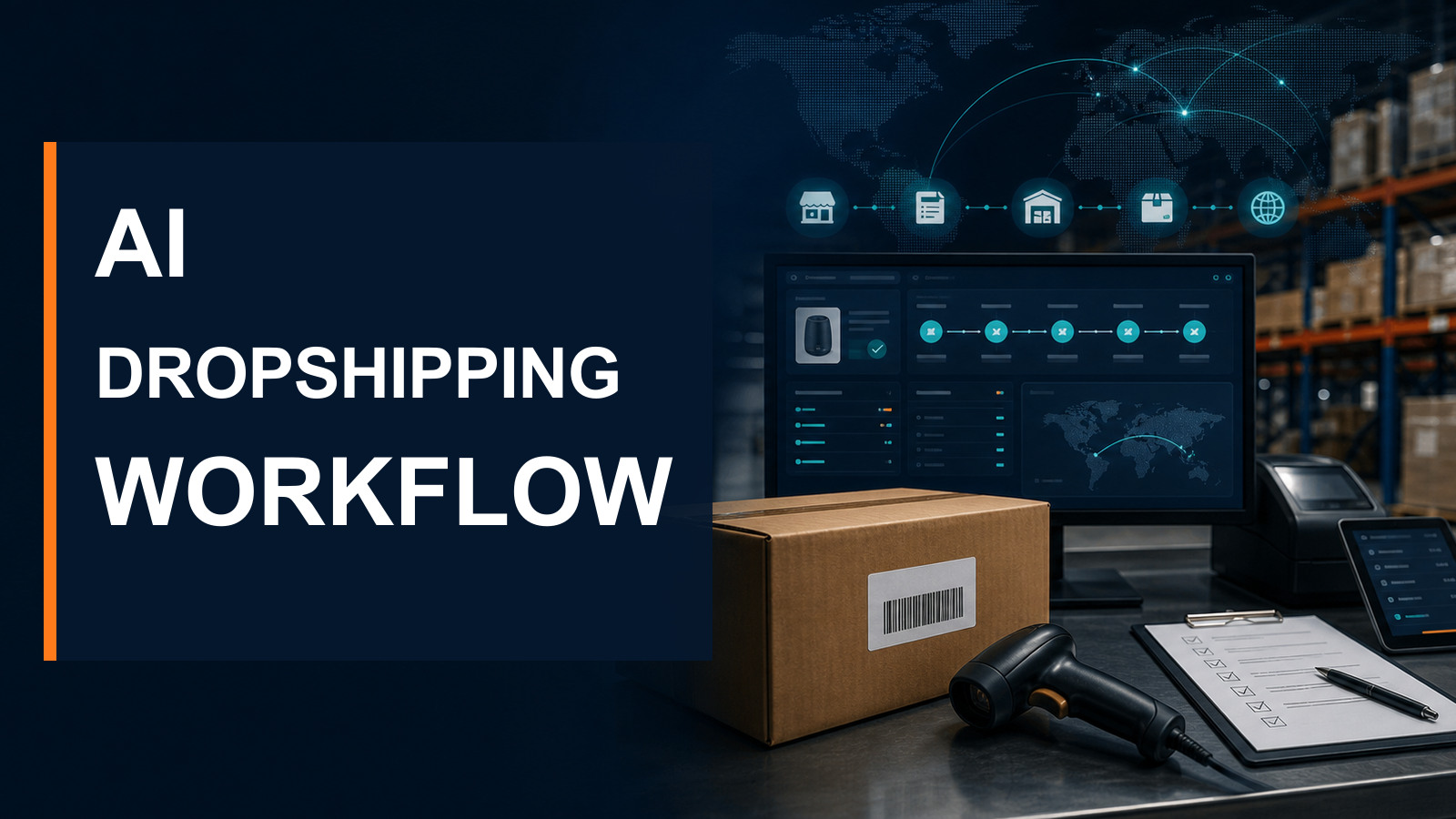
The Seven-Stage AI Dropshipping Workflow
The table below is the operating model. Each stage has a source of truth and a point where automation must stop if the evidence is incomplete.
| Stage | Useful AI work | Source of truth | Human checkpoint | Failure signal |
|---|---|---|---|---|
| 1. Product opportunity | Group demand signals, review complaints, and creative themes | Search, store, ad, return, and marketplace data | Decide whether the opportunity deserves a sample and margin model | Attractive idea with no verifiable demand, economics, or product fit |
| 2. Supplier comparison | Normalize quotes and flag missing terms | Written quote, supplier documents, and communication history | Verify supplier, terms, capacity, and responsibilities | Missing unit definition, MOQ, lead time, Incoterm, defect remedy, or packaging scope |
| 3. Sample and product record | Turn approved facts into a structured specification | Approved sample, measurements, documents, and photos | Approve the saleable version and variant map | Listing data differs from the product that will actually ship |
| 4. Store and marketing | Draft copy, translations, images, segments, and tests | Approved product record and substantiated claims | Approve public claims, price, availability, warnings, and delivery wording | Generated benefit, certification, inventory, or delivery promise lacks evidence |
| 5. Order orchestration | Validate fields, classify risk, reserve stock, and create holds | Commerce platform, payment state, inventory record, and order rules | Release exceptions and high-impact actions | Duplicate order, invalid address, mismatch, high risk, insufficient stock, or unsupported route |
| 6. Physical fulfillment | Prioritize work and detect anomalies | Warehouse scans, counts, QC records, pick confirmation, and carrier events | Resolve holds and confirm unusual handling | Digital status advances without the matching physical event |
| 7. Support and returns | Classify intent, draft replies, and group root causes | Order timeline, policy, tracking, warehouse evidence, and return result | Approve exceptions, liability decisions, and policy overrides | Confident answer conflicts with the actual order or published policy |
One rule connects all seven stages:
AI may explain or act on a verified record. It must not invent an operational event.
A generated sentence cannot make stock available. A label number cannot prove carrier acceptance. A supplier’s “passed QC” message cannot replace the agreed inspection record. The workflow should advance when the source system records the event—not when a model predicts that it probably happened.
1. Use AI to Find Product Questions, Not Declare Winning Products
Product research is a good green-zone task because much of the first pass is reading and pattern recognition. AI can help you:
- group recurring complaints in customer reviews;
- compare how competitors position similar products;
- summarize search questions and use cases;
- identify repeated requests for a feature, size, color, bundle, or accessory;
- create a short list of assumptions to test;
- turn scattered observations into a sample brief.
The output is a hypothesis, not a purchase order.
Before choosing the product, a person still needs to verify whether the demand signal is current, whether the product can be sourced consistently, whether the gross margin survives fulfillment and returns, and whether the item is suitable for the intended market. A trend chart cannot tell you whether the battery documentation is complete. A viral video cannot tell you whether the factory can reproduce the finish shown in the sample.
A useful research brief should end with unanswered questions, such as:
- Which customer problem appears repeatedly across independent sources?
- Which evidence supports the likely selling price?
- What product or shipping characteristic could destroy the margin?
- What must be verified in a physical sample?
- Which claims, warnings, labels, or documents may be required in the target market?
- What would make us stop testing this product?
If the tool gives you only reasons to proceed, the brief is incomplete.
2. Normalize Supplier Quotes Before You Compare Them
Two supplier prices are rarely comparable at first glance. One may include retail packaging, another may quote a bare unit, and a third may exclude an accessory that appears in the sample photo.
AI is useful for extracting and arranging quote details, especially when information arrives across spreadsheets, PDFs, email, and chat. Ask it to put each supplier into the same fields:
| Quote field | What needs to be explicit |
|---|---|
| Product identity | Model, material, dimensions, color, version, plug, language, included accessories |
| Commercial terms | Unit price, currency, MOQ, sample charge, payment schedule, price-validity date |
| Production | Sample lead time, production lead time, capacity assumptions, peak-season constraint |
| Packaging | Unit pack, carton pack, labeling, inserts, customization, packed weight and dimensions |
| Quality | Approved sample, inspection scope, defect remedy, rework responsibility |
| Handoff | Incoterm or delivery scope, pickup location, factory documents, warehouse label requirements |
Then have the tool highlight blanks and contradictions. Do not ask it to fill them.
Supplier approval remains a human decision because the facts behind the spreadsheet must be checked. Review business identity, communication, sample consistency, production readiness, quality arrangements, payment terms, and the remedy if the bulk order differs from the approved version. For a deeper review, use the 15-point China fulfillment partner checklist.
3. Build One Approved Product Record From the Sample
The approved sample is where an idea becomes an operational product. This stage is often skipped because the product page already looks finished.
Create one controlled record for every saleable SKU and variant. At minimum, it should contain:
- internal SKU and supplier model;
- variant values and scannable identity;
- approved product and packaging photos;
- materials, dimensions, net and packed weight;
- included and excluded items;
- operating instructions and warnings where applicable;
- country, age, voltage, plug, battery, liquid, magnetic, fragile, or other relevant attributes;
- packaging, insert, barcode, and bundle rules;
- objective claims and the evidence supporting each claim;
- approved supplier, sample version, and revision date;
- known fulfillment and shipping restrictions.
AI can turn sample notes into a structured draft. The operator should compare the draft with the physical sample and source documents before it becomes the record used by the store, warehouse, ads, and support team.
This product record prevents a common form of silent drift. Marketing calls a color “sand,” the supplier calls it “beige,” and the warehouse receives a barcode associated with “cream.” All three labels may sound reasonable to a model. Only the approved variant mapping tells the operation whether they are the same SKU.
4. Generate Ads and Store Content, Then Run a Claims Check
Writing assistance is useful. Publishing without a factual review is not.
Shopify’s own guidance for automatic product descriptions warns that generated text can introduce benefits or facts that were not provided and says the merchant remains responsible for accuracy. The U.S. Federal Trade Commission similarly states that advertising claims must be truthful, non-deceptive, and evidence-based.
Before publishing generated product content, check:
- Identity: Does the title describe the exact variant being sold?
- Specifications: Do dimensions, weight, material, compatibility, capacity, and included items match the approved product record?
- Performance: Is every measurable or comparative claim supported?
- Safety and compliance: Are certifications, warnings, age guidance, and permitted uses stated accurately for the target market?
- Price and availability: Do the product feed, landing page, structured data, and checkout agree?
- Shipping: Is the delivery wording based on a current product-and-destination route rather than a general promise?
- Returns: Does the page match the published return policy and the actual return path?
- Images: Do generated or edited visuals avoid showing features, quantities, accessories, or results the customer will not receive?
Google Merchant Center requires submitted price and availability data to match the landing page, checkout, and structured data. That makes inventory and pricing sync a source-data problem, not a copywriting task.
Use AI to make several angles quickly. Use the approved record to decide which one is true.
Create more testable ad material from the same verified product
The creative benefit is not that a model knows the perfect ad. It is that a small team can turn one sound brief into more testable versions without rebuilding every asset from zero.
Start with customer language from reviews, pre-purchase questions, support tickets, and return reasons. Remove personal information, preserve the original context, and ask AI to group the material into:
- problems customers are trying to solve;
- objections that prevent a purchase;
- features customers misunderstand;
- use cases that deserve a demonstration;
- proof the customer would need before believing a claim;
- questions the current product page fails to answer.
For each verified angle, create a small creative set: a hook, a product demonstration, one proof point, one objection answer, and one CTA. The same approved message can then be adapted into static placements, short-video scripts, captions, voiceovers, email blocks, and localized versions.
This does not make every variation good. It makes the cost of learning lower. A human still needs to reject generic hooks, impossible product scenes, distorted packaging, unsupported before-and-after results, incorrect quantities, and edits that make the product look different from the item being delivered.
Improve conversion by closing information gaps
AI does not raise conversion rate merely by being present on a store. It can improve the speed and quality of conversion work when it helps the team find and test a specific source of friction.
Useful applications include:
- matching the ad promise to the exact product-page section that proves it;
- converting repeated customer questions into clearer specifications, comparison blocks, size guidance, delivery explanations, or FAQs;
- proposing alternative headlines, benefit order, image captions, and CTA language for a controlled test;
- helping shoppers compare compatible products or variants using current catalog and inventory data;
- summarizing session recordings and support conversations to locate confusion or missing information;
- identifying where an unexpected return reason points back to the product page rather than the warehouse or carrier.
Measure the whole commercial result. A page variation that raises conversion while increasing wrong-fit purchases, refunds, support load, or discount cost may be worse for the business.
| Use case | Potential benefit | Measure | Guardrail |
|---|---|---|---|
| Review and ticket clustering | Finds repeated customer language faster | Time to usable brief; number of evidence-backed angles | Keep source context; do not treat a few comments as market size |
| Static and video variations | Produces more placement-ready tests from one approved brief | Production lead time; usable asset rate; CTR and CPC by concept | Keep product, quantity, function, offer, and disclosures accurate |
| Product-page clarification | Answers objections and aligns the page with the ad | Add-to-cart rate; checkout start; conversion rate; product-question rate | Change one meaningful variable at a time and retain the approved facts |
| On-site shopping help | Answers product and policy questions while intent is high | Assisted conversion; handoff rate; answer quality; complaint rate | Use current catalog, stock, price, policy, and authenticated order data |
| Segmentation and retention | Makes messages and recommendations more relevant | Repeat purchase; revenue per recipient; unsubscribe rate; contribution margin | Respect consent, frequency limits, inventory, discounts, and exclusions |
| Operations summaries | Surfaces stock, order, support, or return exceptions sooner | Manual touches; exception age; resolution time; repeated-error rate | Every summary must link back to source records |
Do not credit AI with a conversion lift unless the test design and analytics support that conclusion. Compare the variation with a relevant baseline, review enough traffic to make a decision, and track contribution margin and post-purchase outcomes alongside conversion rate.
Reduce recurring store-operating work
The store-operations benefit is usually less glamorous than a generated video, but often more durable. AI can help a team:
- draft and update product, collection, FAQ, email, and help-center content from approved records;
- create customer segments and prepare relevant campaigns;
- summarize sales, traffic, product, support, and return reports;
- flag products with rising questions, returns, stock risk, or falling conversion;
- prepare merchandising, bundle, and replenishment questions for review;
- classify tickets and route routine requests;
- turn a repeated manual rule into a proposed automation workflow.
Keep the write permissions narrow. A report may be safe to generate automatically. A discount, product edit, campaign launch, refund, or order release may need a preview, threshold, or named approver.
5. Automate Orders Through Explicit States and Holds
“Automate fulfillment” is too vague to be safe. Break the order into states that have evidence and an owner.
| Order state | What it means | What should not happen yet |
|---|---|---|
| Created | The order exists in the commerce system | Do not assume payment, stock, or route eligibility |
| Paid | The required payment state is confirmed | Do not release if fraud, address, inventory, product, or route checks fail |
| Reserved | The required stock is assigned to the order | Do not treat reservation as picking |
| Held | A defined exception blocks release | Do not silently bypass the hold because a deadline is approaching |
| Released | Required checks passed and the warehouse may act | Do not mark the order shipped |
| Picked and packed | Physical units were selected and packed | Do not claim carrier possession unless the handoff event exists |
| Carrier accepted | The parcel entered the carrier network | Monitor tracking and exceptions; do not invent delivery progress |
Shopify documents fulfillment holds for situations such as fraud risk, unavailable inventory, high order value, or other defined conditions. A hold can block fulfillment while inventory remains reserved. That is a useful control pattern even if you use a different commerce stack: questionable orders should enter a visible queue, not disappear into an integration log.
Good yellow-zone automations include:
- accept only paid orders from approved channels;
- check required customer and address fields;
- map every order line to one valid warehouse SKU;
- reserve available stock once;
- hold duplicates, mismatches, high-risk orders, unsupported products, and missing route data;
- notify the correct owner with the reason and supporting record;
- release only when the hold has an approved resolution;
- write the resulting state back to the store.
The most important feature is not speed. It is the ability to stop.
6. Connect Digital Decisions to Physical Fulfillment Evidence
At the warehouse, the product leaves the world of prompts and enters the world of counts, labels, shelves, packaging, and carrier handoffs.
AI can help prioritize an exception queue, summarize receiving differences, suggest a packaging instruction, or flag an unusual order pattern. It cannot physically confirm that 96 blue units and 4 mislabeled black units arrived. That fact needs a receiving record, scan, count, photo, or inspection result.
A controlled 3PL inbound receiving process should separate:
- arrived — custody of the shipment was recorded;
- received and reconciled — SKU identity and quantity were checked against the inbound record;
- available to fulfill — approved units passed the required checks and entered sellable stock.
Once orders begin, ask a fulfillment provider these questions:
- Can every store variant map to one warehouse SKU without manual guessing?
- Which inventory states are visible: inbound, available, reserved, held, damaged, and returned?
- Can the system hold an order without losing the reservation?
- Are exception reasons specific enough to act on?
- Which physical event creates pick, pack, handoff, and tracking updates?
- Can a person override an automation with a reason and audit record?
- How are inventory adjustments, rework, split shipments, and address changes recorded?
- What happens when the connection fails or sends the same order again?
- Can the brand export its order, inventory, tracking, and exception history?
- Who owns a route, product-restriction, customs, or delivery exception?
If these answers live only in sales language, the automation layer does not yet have a stable foundation.
7. Let Support Draft; Make the Order Timeline Answer
Customer support is a strong use case for classification and drafting. A model can identify that a customer is asking about an address change, a tracking delay, a missing item, or a return. It can retrieve the relevant policy and prepare a response.
The final answer should come from the order timeline and evidence:
- Was the address-change request received before or after release?
- Which SKU was ordered, picked, and packed?
- Was the parcel only labeled, or accepted by the carrier?
- Which tracking event is the latest verified event?
- Does the request fall inside the published policy?
- Is a refund or replacement routine, or does it require an exception owner?
After resolution, record a useful reason code. “Customer unhappy” teaches the operation very little. “Wrong color picked,” “listing dimensions unclear,” “carrier delay,” “factory defect,” and “customer ordered incompatible version” point to different owners and corrective actions.
The return is not the end of the workflow. It is new product, supplier, warehouse, listing, or route evidence for the next decision.
Choose a Tool Stack by Job, Not by Logo
Tool lists age quickly. The operating roles are more durable.
| System layer | Authoritative data | Useful AI role | Allowed write action | Red flag |
|---|---|---|---|---|
| Research workspace | Source links, observations, test results | Summarize and cluster | Draft a hypothesis or brief | Invented market size or unsupported demand claim |
| Product record | Approved sample facts and revisions | Structure and compare | Propose a field update | Silent change to a live SKU, claim, or variant |
| Commerce platform | Product, price, customer, payment, and order state | Assist merchandising and risk review | Update approved content or place a hold | Publishing facts or releasing orders without the required gate |
| Integration layer | Field maps, triggers, logs, and retry state | Classify errors and recommend routing | Move approved data between systems | Duplicate creation, hidden retries, or no rollback |
| Fulfillment system | Inventory, receiving, pick, pack, and shipment events | Prioritize and detect anomalies | Create controlled work or exception tasks | Digital status without physical evidence |
| Support system | Customer message, policy, and order timeline | Classify and draft | Send low-risk approved replies | Hallucinated order status or unauthorized remedy |
| Analytics and audit | Event history, costs, exceptions, and outcomes | Find patterns and summarize | Create reports and alerts | Dashboard number that cannot be traced to source records |
Before adding a tool, write down four things:
- Which system remains the source of truth?
- What may this tool read?
- What may it write or trigger?
- How will you detect, stop, and reverse a wrong action?
If the vendor cannot answer those questions, another feature demo will not solve the problem.
AI Tools and AI-Enabled Platforms Worth Testing Against Profit
This is not a recycled “best AI tools” list. For this section, we reviewed current official product and help pages across product intelligence, ad production, creative analysis, on-site selling, personalization, pricing, marketing analytics, inventory, customer experience, returns, fraud, and AI shopping channels. Current Shopify App Store listings and recent merchant reviews were also checked where available, but only as adoption and implementation signals. A review, vendor case study, attribution dashboard, or modeled uplift does not prove incremental profit.
Sales and profit are not the same result. A tool can lift conversion while giving away too much discount, increase average order value while adding low-margin items, or report “revenue influenced” that would have happened anyway. Use a fuller calculation:
Incremental contribution = incremental gross profit + retained value + avoided loss − extra media spend − discounts − returns and shipping − software − implementation − additional support cost.
The shortlist below is non-ranked. Each product has a specific job, metric, and stop condition. Capabilities, access, pricing, integrations, and data practices can change; these descriptions were verified from the linked provider or platform documentation on August 19, 2026.
| Profit job | Tool or platform | What to test | Count as success | Hold, stop, or review when |
|---|---|---|---|---|
| Find a better assortment or price hypothesis | Particl | Use competitor product, pricing, promotion, and estimated sales signals to shortlist opportunities | A sourced hypothesis survives supplier quotes, sample review, landed-cost modeling, and a real market test | Treat estimated sales, inventory, market size, and “opportunity” scores as directional data—not audited competitor truth or proof that a product will sell |
| Produce more ad concepts from verified product inputs | Creatify | Turn an approved product page and real assets into several editable video-ad angles | Cost per usable asset falls and the variants improve contribution after ad spend in a controlled creative test | Reject invented demonstrations, altered product details, fake testimony, unsupported claims, poor localization, or unclear likeness, music, and commercial-use rights |
| Learn why paid creative is winning or fatiguing | Motion | Analyze actual Meta, TikTok, YouTube, or LinkedIn creative data and turn recurring patterns into the next brief | Creative winner rate improves, wasted spend falls, or CPA improves without weaker margin or post-purchase quality | Do not buy it before there is enough spend and variation to analyze. Platform attribution and pattern detection are not proof of incrementality |
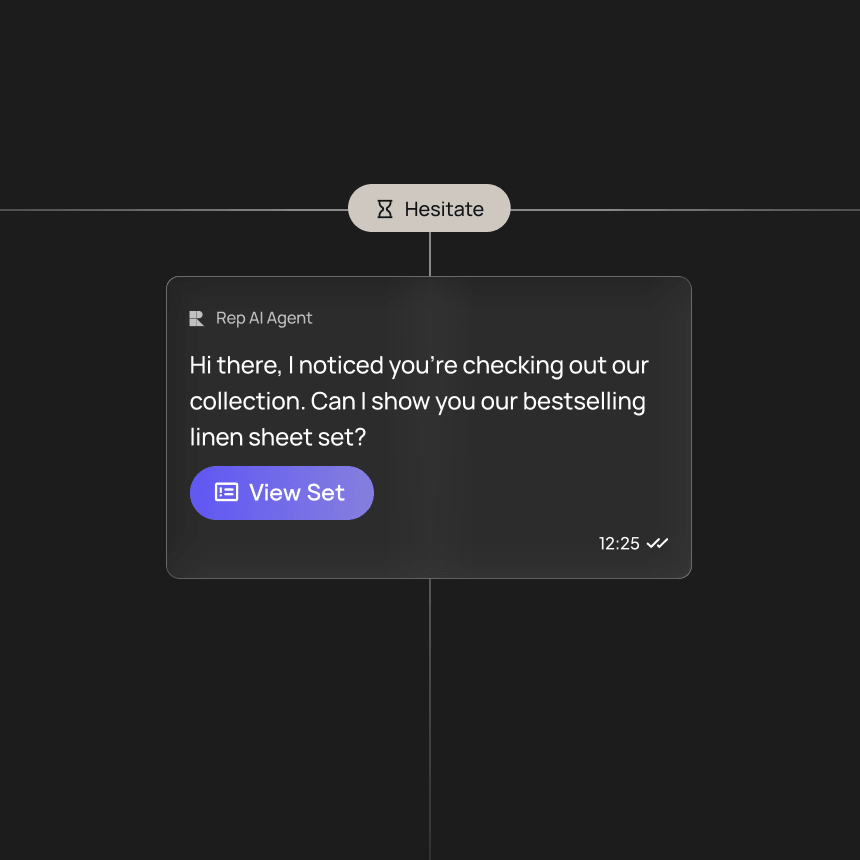
| Resolve pre-purchase hesitation in the session | REP AI | Answer fit, compatibility, product, policy, and stock questions; recommend relevant products; hand off uncertain cases | Assisted conversion and revenue per 1,000 eligible sessions rise after software, discounts, refunds, and support costs | Require current price, stock, variant, and policy data. Do not let an unauthenticated chat change orders, expose customer data, or invent a delivery promise |
| Raise basket value and repeat purchase | Rebuy | Test product recommendations, cart offers, checkout or post-purchase offers, re-order flows, and personalization | Contribution margin per session or order rises—not just attributed upsell revenue or AOV | Watch discount cannibalization, irrelevant offers, subscription confusion, app conflicts, page speed, and the margin of the recommended products |
| Improve price and markdown decisions | Shopify Smart Pricing | Review machine-learning price tips or run an eligible A/B pricing experiment before making a permanent change | Store-level profit, profit per visitor, and units sold improve within the test boundary | A/B price tips are early access, eligibility varies, and the app is not compatible with third-party personalization apps. Populate accurate cost per item and review every price change |
| Reduce blanket discounting | Promi | Test whether targeted discount depth converts price-sensitive shoppers without discounting everyone | Incremental gross profit beats the holdout after the discount, tool fee, refunds, and repeat-purchase effects | Personalized offers need brand, customer-trust, privacy, and applicable legal review. Never call a conversion lift profitable without a control group and margin result |
| Turn fragmented data into operating decisions | Triple Whale Moby 2 | Connect commerce and marketing data, investigate performance changes, schedule reporting, and prepare or execute supported actions with approvals | The team makes faster decisions and improves verified contribution margin, blended acquisition efficiency, or forecasting accuracy | Reconcile source fields and attribution models first. Put approval, budget, and write limits around campaign, audience, content, and automation actions |
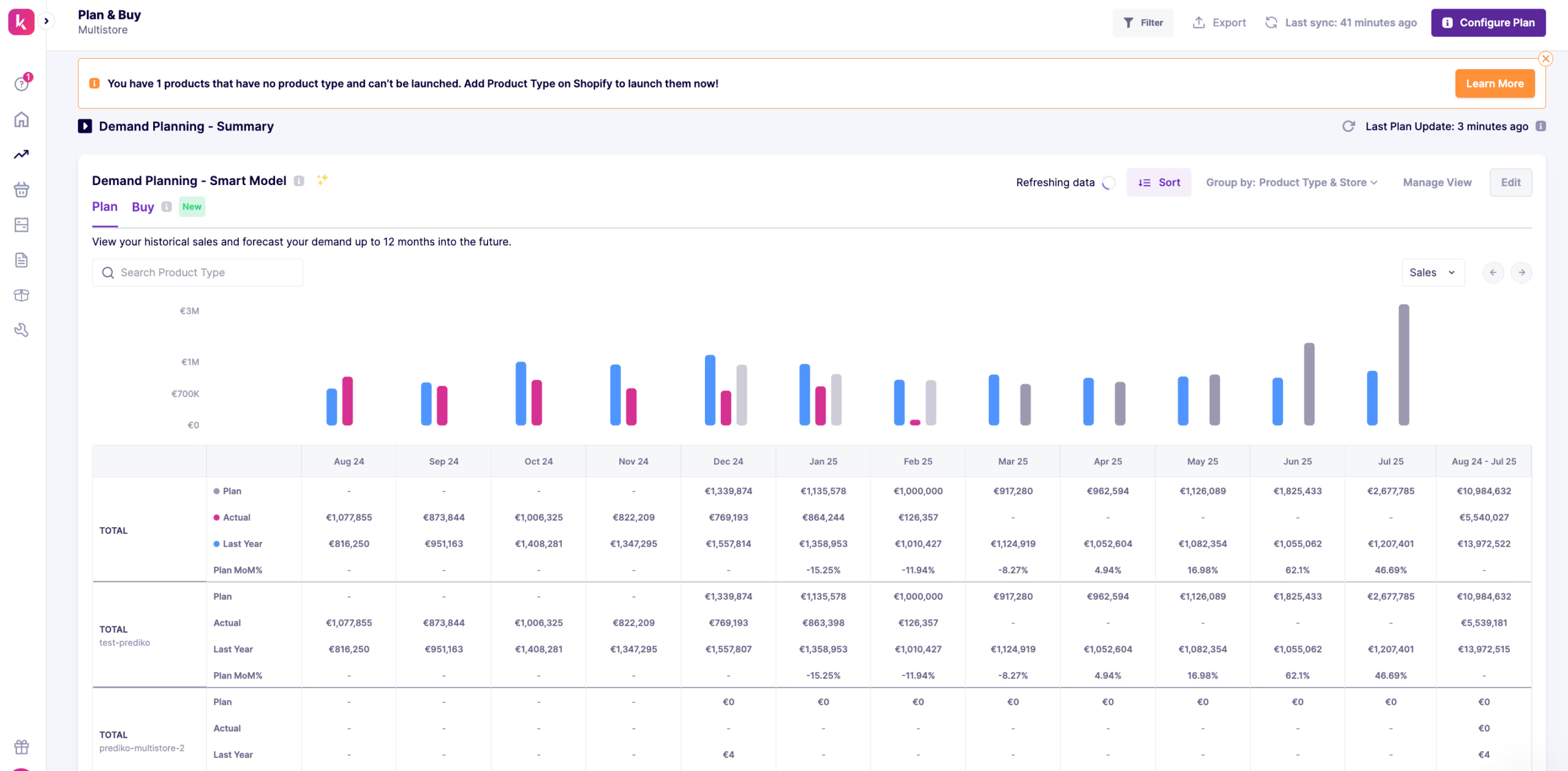
| Reduce stockouts, overstock, and cash tied in inventory | Prediko | Forecast by SKU and season, review reorder alerts, and turn approved recommendations into purchase orders | Forecast error, stockout days, excess weeks of cover, emergency freight, or inventory cash improve | Clean SKU history, bundles, promotions, lead times, incoming stock, and warehouse inventory first. Keep purchase orders human-approved until back-testing and live variance are acceptable |
| Convert or resolve customer conversations at lower cost | Siena | Start with a bounded set of shopping, tracking, subscription, or routine support intents across the connected commerce stack | Cost per resolved conversation falls while assisted sales, save rate, CSAT, and policy compliance remain healthy | Authenticate account actions, cap remedies, test edge cases, preserve transcripts and handoff, and keep refunds, cancellations, and unusual exceptions within explicit authority |
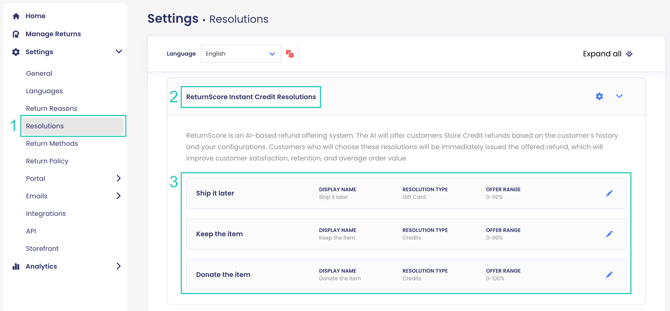
| Retain value when a customer wants to return | ReturnGO | Offer policy-eligible exchanges or store credit, automate routine RMAs, and analyze return reasons and abuse signals | Retained contribution after incentives, labels, handling, reshipment, repeat returns, and software cost beats a refund-first baseline | Reconcile exchange orders with Shopify, finance, inventory, and the WMS. Do not pressure customers, hide refund rights, or assume every cross-border return should be physically shipped back |
| Approve good orders while limiting fraud loss | Signifyd | Compare AI order decisions and guaranteed protection with the current fraud and manual-review process | Legitimate approval rate improves net of chargebacks, guarantee fees, false declines, review labor, and fulfillment losses | Confirm contract coverage, reimbursement conditions, platform integration, and excluded scenarios. A digital approval should release fulfillment only through the defined order-state gate |
| Make products discoverable in AI shopping journeys | Shopify Agentic Storefronts | For eligible stores, expose accurate catalog data to supported AI channels and measure attributed visits and orders | AI-referred sessions and orders add positive contribution instead of merely shifting existing traffic attribution | Availability and direct-purchase support vary by channel. Audit titles, variants, identifiers, price, stock, images, policies, and checkout before treating the channel as ready |
The interface images below are official provider-hosted product or help-center examples checked on August 19, 2026. They help readers see the workflow being described. They do not independently verify conversion lift, savings, accuracy, or profitability. Sample values may be demonstration data, and interfaces can change after publication.
Which tools should a store test first?
Do not install the whole table. Match one purchase to the current constraint:
- A new store with little traffic usually needs verified product economics and usable creative before an expensive analytics stack. Particl can inform hypotheses; Creatify can expand an approved concept; neither replaces a sample or a real test.
- A store buying traffic but losing shoppers on product pages should examine unanswered questions and merchandising. Test REP AI or Rebuy against a defined session group before running both.
- A store with sales history but uncertain margins should investigate pricing and contribution data. Shopify Smart Pricing may be the lowest-friction test for eligible stores; Triple Whale is more appropriate when several channels and data sources need reconciliation.
- A store holding meaningful inventory should address stockout and overstock economics before adding more acquisition spend. Prediko becomes useful only when SKU, inventory, promotion, and lead-time inputs are reliable.
- A store with material ticket, return, or fraud volume can evaluate Siena, ReturnGO, or Signifyd against the current cost and loss baseline. The saved labor or retained revenue must exceed software, implementation, incentives, and exception costs.
Run a profit test, not a vendor demo
Before granting broad access, run one bounded use case:
- Record at least one representative baseline period and define the eligible traffic, orders, SKUs, or conversations.
- Choose one primary metric and two guardrails—for example, contribution per session, with refund rate and CSAT as guardrails.
- Use a holdout, A/B test, or staggered launch when the platform and traffic allow it.
- Include media, discount, return, shipping, labor, implementation, and software costs.
- Define the kill rule before launch, not after a disappointing month.
- Export results, review false positives and exceptions, and confirm that the workflow can be disabled or rolled back.
Shopify Flow, Zapier, Make, or another integration platform may connect these tools, but a connection is not evidence that the underlying product, inventory, order, or shipment fact is correct. Keep the source of truth, hold rules, permissions, and reversal path defined first.
How PICKOSHIP Fits an AI-Assisted Dropshipping Operation
PICKOSHIP’s relevant model begins after the product and supplier decisions have a physical version. Factory-made goods can be sent into one China inventory pool rather than being pre-positioned in multiple destination-country warehouses. Store orders can then flow into an agreed fulfillment process for order-level international delivery.
PICKOSHIP provides inventory receiving, agreed-scope quality checks, inventory recording, pick and pack, store order connection, tracked international shipping, and product- and destination-specific returns planning. Exact service scope, eligibility, fees, routes, exceptions, and responsibilities are confirmed in a written fulfillment plan and current quotation.
In that model, AI may help the brand forecast, draft instructions, classify exceptions, or analyze return reasons. The operational record still comes from receiving, inventory, order, warehouse, and tracking events.
Important conditions remain visible:
- up to 180 days of free storage applies only to qualifying inventory;
- dispatch within 24 hours applies only to paid, synchronized, in-stock orders that pass the required checks;
- routes, DDP treatment, product restrictions, and exception fees require written product- and destination-specific confirmation.
This model may suit brands that want supplier coordination in China, one inventory pool, order-level fulfillment, and tracked international shipping without stocking every target market in advance. It is not automatically suitable for every product, destination, delivery promise, customs requirement, or return strategy. Compare the operating model and landed-cost assumptions before committing inventory; this one-China-warehouse versus overseas-stock example shows the questions to model.
A 30-Day Rollout Without Pretending the Store Is Autonomous
Do not connect every tool in week one. Build the control layer in the same order that risk enters the operation.
Week 1: Map records, decisions, and owners
- list the systems holding product, supplier, inventory, order, shipment, and return data;
- choose the source of truth for each field;
- document the order states and allowed transitions;
- list recurring exceptions and assign an owner;
- identify high-impact actions that require approval;
- record the current baseline before automating anything.
Deliverable: one workflow map with systems, owners, gates, and unresolved data conflicts.
Week 2: Automate green-zone work
- summarize research and reviews;
- normalize supplier quote fields;
- draft product content from approved facts;
- classify support requests;
- prepare daily exception summaries;
- require review before any public or customer-facing output.
Deliverable: saved time without automatic inventory, order, spend, refund, or fulfillment changes.
Week 3: Add one yellow-zone workflow
Choose a narrow process, such as syncing paid orders that have a valid SKU map and complete address fields. Add:
- entry conditions;
- a duplicate check;
- clear hold reasons;
- an alert and owner;
- an action log;
- a manual release or rollback;
- a small test set covering normal and failure cases.
Deliverable: one controlled automation that fails visibly.
Week 4: Stress-test exceptions and decide whether to expand
- test stale inventory, missing SKU, duplicate order, address error, high-risk payment, route restriction, and integration failure;
- compare errors and manual work with the baseline;
- review customer and warehouse outcomes, not only tool activity;
- repair the source data or process before adding more automation;
- expand only if the owner can explain what happened on every test order.
Deliverable: keep, change, or roll back the workflow based on evidence.
Measure Whether Automation Is Reducing Work or Hiding It
A dashboard full of generated content and completed tasks can look productive while exceptions move downstream.
Track operational measures that expose the handoff:
| Measure | What to ask |
|---|---|
| Source-data freshness | How old was the inventory, price, route, or policy record when the action occurred? |
| Stock mismatch events | How often did the store, integration, and warehouse disagree? |
| Hold and exception rate | Which orders stopped, and for what reason? |
| Manual touches per order | Did work disappear, or move into correction and support? |
| Release time | How long did eligible orders wait before warehouse release? |
| Wrong-item or variant incidents | Did faster order flow increase physical mistakes? |
| Tracking exceptions | How often did a status lack the expected carrier event? |
| Refund and return reason quality | Can each outcome be assigned to product, supplier, listing, warehouse, carrier, or customer choice? |
| Rollback time | How quickly can the team stop and reverse a faulty automation? |
Set a baseline using your own operation. Do not borrow a “good” benchmark from a software sales page if the product mix, order volume, service level, and exception definition are different.
Best For / Not For
AI-assisted dropshipping is a better fit when:
- products and variants have stable identifiers;
- samples and objective claims are verified;
- inventory and order states are visible;
- suppliers and fulfillment partners follow documented handoffs;
- the business has enough repeated work to justify automation;
- exceptions have owners and response rules;
- the team is willing to review outcomes and roll back errors.
It is not ready for broad automation when:
- products are imported before anyone verifies the physical version;
- supplier stock and pricing cannot be trusted;
- listings contain unsupported performance, safety, or certification claims;
- store variants do not map reliably to warehouse SKUs;
- orders can jump directly from paid to shipped without holds;
- no one owns compliance, customs, returns, or delivery exceptions;
- the business needs the tool to hide an unprofitable unit model.
Automation magnifies the process it receives. Clean inputs and explicit controls scale useful work. Ambiguous inputs scale ambiguity.
Frequently Asked Questions
What is AI dropshipping?
AI dropshipping is the use of AI-assisted research, generation, classification, prediction, or agent-like actions within a dropshipping operation. It may support product research, supplier comparison, product content, merchandising, order review, support, and analytics. The physical product still requires a supplier and a fulfillment process, and the merchant remains responsible for what is sold and promised.
Can AI run a dropshipping store automatically?
It can automate parts of a store, but “fully automatic” is a poor operating goal. Supplier changes, product quality, objective claims, fraud, inventory discrepancies, shipping restrictions, customs treatment, carrier exceptions, and returns can require evidence and human judgment. A safer goal is a controlled workflow that automates routine cases and makes exceptions visible.
What should I automate first in dropshipping?
Start with reversible tasks: research summaries, quote normalization, content drafts based on approved facts, ticket classification, and exception summaries. Next, automate one narrow order workflow with entry rules, holds, alerts, logs, and rollback. Do not begin with automatic supplier approval, inventory release, broad refunds, or unsupported shipping promises.
What is the best AI tool for dropshipping?
There is no universal best tool. Choose by job and control: research, product record, commerce, integration, fulfillment, support, or analytics. Confirm its source data, permissions, logs, failure behavior, export path, and human override before comparing extra features.
Can AI choose a winning dropshipping product?
AI can organize demand signals and identify testable patterns. It cannot guarantee demand, margin, supplier consistency, product quality, compliance, or delivery performance. Treat its output as a hypothesis and verify the product, economics, target market, and fulfillment path before scaling.
Which dropshipping decisions should remain human-approved?
Keep approval for suppliers, samples, objective product and compliance claims, inventory release after exceptions, unusual high-value refunds, product- or destination-specific shipping choices, and any action with serious safety, legal, financial, or irreversible consequences.
How does AI connect to a China fulfillment warehouse?
The connection should use structured product, SKU, inventory, order, exception, and tracking records. AI can help interpret or prioritize those records, while automation moves approved data. Warehouse scans, counts, QC records, pick and pack confirmation, and carrier events remain the evidence for physical execution. Review PICKOSHIP’s fulfillment service model and global shipping approach for the operational handoff.
Is AI dropshipping legal?
Using AI does not remove the merchant’s obligations. Applicable product-safety, advertising, privacy, tax, customs, consumer-protection, and platform rules depend on the product, business, and markets involved. Shopify’s dropshipping guidance states that merchants remain responsible for offering safe products and complying with applicable requirements. Obtain qualified advice for the jurisdictions and product categories you serve; this article is operational guidance, not legal advice.
Methodology, Disclosure, and Sources
This guide was developed by Pickoship fulfillment from an operator-control perspective. We reviewed current official guidance for generated content, fulfillment holds, dropshipping responsibility, advertising substantiation, product-data accuracy, and AI risk management. For the commercial-tool section, we separately screened current provider documentation across market intelligence, advertising, on-site conversion, personalization, pricing, analytics, inventory, customer experience, returns, fraud, and AI shopping channels. Current Shopify App Store listings and recent merchant reviews were used only as adoption and implementation signals—not as proof that a tool caused incremental revenue or profit. We then mapped those findings across a digital-to-physical dropshipping workflow. No performance benchmark, customer outcome, or “fully autonomous” claim is presented as an independently established result.
PICKOSHIP is a fulfillment provider and may benefit if a reader requests its services. Service descriptions are first-party statements. Scope, eligibility, routes, pricing, restrictions, DDP treatment, exception fees, and responsibilities require a current written plan and quotation.
Primary, official, and provider references reviewed August 19, 2026:
- Shopify Help: Tips for using Shopify Magic text generation
- Shopify Help: Automatically generating product descriptions
- Shopify Help: Shopify Magic
- Shopify Help: Generating content with Sidekick
- Shopify Help: Fulfillment holds
- Shopify Help: Legal considerations for dropshipping
- Shopify Help: Smart Pricing
- Shopify Help: Agentic storefronts
- Federal Trade Commission: Advertising and Marketing Basics
- Google Merchant Center: Product data specification
- NIST AI Risk Management Framework and AI Resource Center
- Particl: Ecommerce market intelligence
- Creatify: AI ad-production platform
- Motion: AI-powered creative analytics
- Shopify App Store: REP AI
- REP AI: Agentic commerce platform
- Shopify App Store: Rebuy
- Promi: AI-personalized discounts
- Triple Whale Help: Moby 2
- Shopify App Store: Prediko
- Prediko Help: Shopify product and inventory data sync
- Prediko: Product updates and interface examples
- Siena: Commerce AI agents
- Siena: Integrations
- ReturnGO Help: ReturnScore instant-credit resolutions
- ReturnGO Help: Exchanges
- Signifyd: Guaranteed Fraud Protection
Update note: Recheck platform documentation, regulatory guidance, PICKOSHIP service conditions, and all product- or destination-specific statements before publication and during future updates.
Want to connect store automation to a controlled physical workflow?
Share your product category, SKU count, sales channels, monthly order range, target destinations, and current bottleneck. PICKOSHIP can outline the handoffs, checks, and product- or destination-specific questions that need written confirmation.